

Beyond Decoration: Using Islamic Wall Art as a Spatial Tool
High-contrast, mathematically precise visual anchors immediately down-regulate the central nervous system. A well-designed entryway uses this principle to engineer a rapid psychological transition from chaotic external worlds to domestic quiet. A Mayfair luxury hotel lobby achieves instant calm by employing a singular, commanding architectural focal point. At home, clustered 10x15cm MDF photograph frames with weak contrast fail to interrupt mental momentum. Treating a Victorian terrace corridor as a clinical decompression zone fundamentally changes spatial interaction. Curating deliberate Islamic wall art for UK interiors requires viewing the entryway as an active psychological buffer.
How High-Contrast Anchors Force Biological Down-Regulation
Environmental psychology studies from University College London demonstrate that a behavioral pause at a spatial threshold triggers an immediate drop in central nervous system cortisol. Installing an intentional, high-contrast Kufic visual anchor at an entryway effectively grounds the space to force this pause. The brain demands rapid cognitive resolution to navigate spatial confinement. Low-light, high-traffic corridors compound this biological need. Hanging the Al-Masjid an-Nabawi: Islamic Canvas Print on a 90cm wide alcove provides crisp architectural lines for instant sensory comfort. The eye stops searching, and the body relaxes.

Muted Tones Fail in Tight Spaces
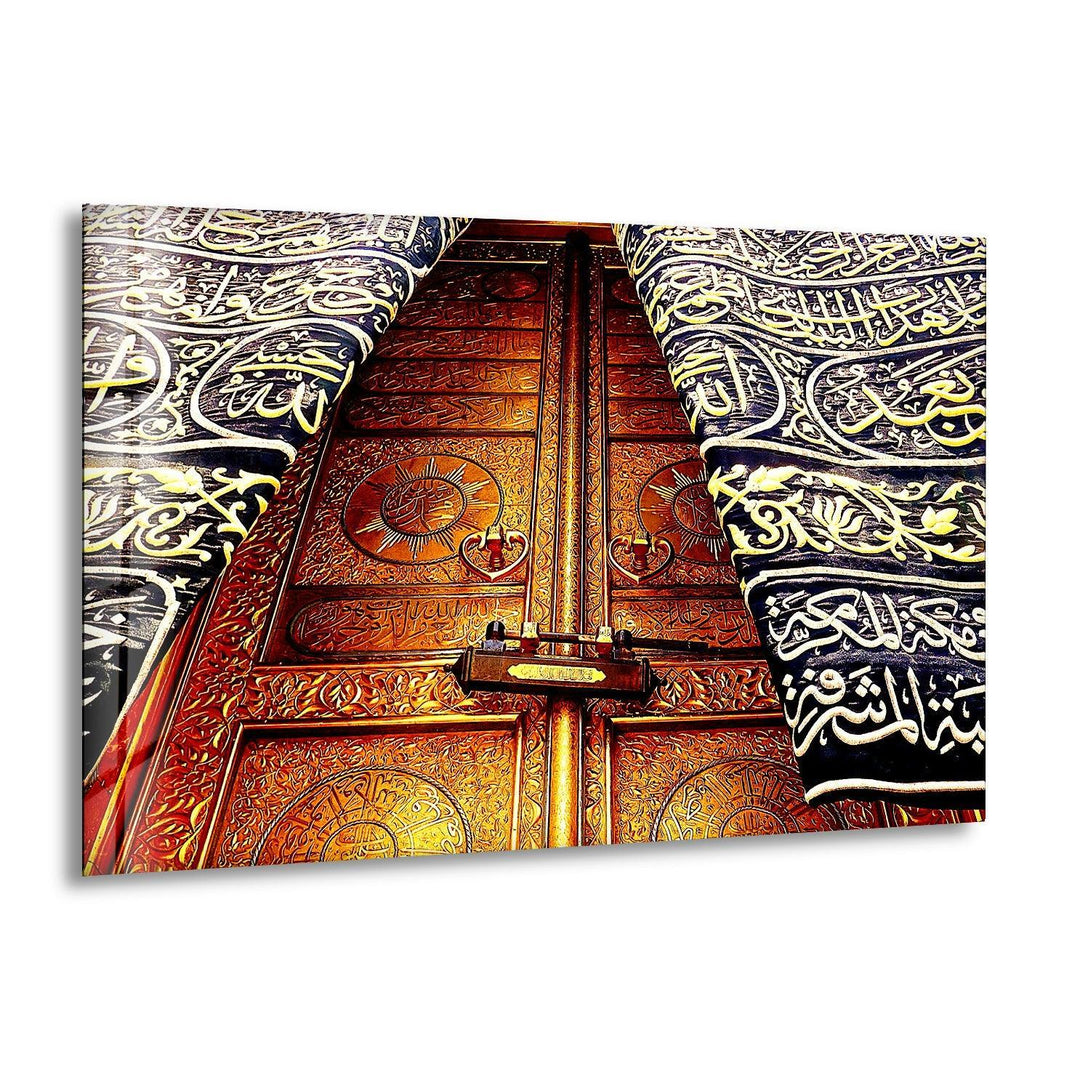
Visual peace in transitions requires bold, saturated Thuluth calligraphy, whereas conventional design wisdom wrongly dictates using faded sage watercolors to foster tranquility. In low-light entryways, faded 300gsm cotton prints force subconscious micro-strain, increasing cognitive load. A mathematically precise script in stark India ink against obsidian-black acrylic captures the gaze instantly. It cuts through mental chatter, lowering cortisol via immediate visual resolution. This principle works actively in the Divine Dawn: Kaaba Emerging Through Light and Stone Glass Wall Art. The striking contrast provides the exact rapid cognitive resolution the brain craves.

Traditional geometric Islamic art scholarship frames classical Naskh scripts as a visual liturgy inviting the soul into Sakinah (divine tranquility). This aesthetic relies entirely on applied Euclidean mathematics. During the 10th century, Arabic script proportions were codified using the rhombic pen dot, or nuqta. A vertical Alif measures exactly 7 to 9 nuqtas. This rigorous mathematical relationship between dark ascenders and negative space creates a rhythmic meditation. The resulting geometric calligraphy acts as a biological down-regulation tool for narrow corridors.
The Illusion of Expanding Narrow Corridors
A large 80cm x 120cm canvas mathematically expands the perception of narrow 90cm-wide spaces by forcing the eye to read the wall as a single unified plane. Hanging a gallery wall of 15cm x 20cm prints fractures the visual field and increases spatial anxiety. RIBA-chartered architects note that scaling up art in confined vestibules makes tight spaces feel larger. A commanding piece like the Sacred Serenity: Al-Masjid an-Nabawi Medina Canvas Print pushes physical boundaries outward. To ground this illusion, apply the two-thirds rule: the 300gsm canvas must span 60 to 75 percent of the wall segment. When placing a mid-century oak console underneath, position the frame's bottom edge exactly 15 to 20 cm above the tabletop. This prevents floating art syndrome.

Precision Hanging Prevents Cervical Tension
Hanging artwork with its horizontal centerline positioned exactly 145 cm from the floor prevents cervical spine tension caused by gazing upward in confined 1.2-meter corridors. Aligning frame tops with standard 204 cm door casings places the center at 165 cm or higher, which triggers vigilance and spatial anxiety. Adhere strictly to the 145 cm midline. Selecting ultra-slim matte black aluminum gallery frames with a low-profile depth under 2.5 cm is vital. Thick shadowboxes cast heavy visual shadows under 3000K LED lights and create shoulder-snagging hazards. Minimalist frames keep pathways clear.
When installing multiple triptych panels, gallery spatial framing principles mandate a gap of exactly 3.8 to 6.3 cm between panels. In typical residential hallways, apply the 1:12 spacing ratio, placing pieces exactly 3.8 to 5 cm apart. Exceeding this boundary breaks the continuous horizontal flow of the script. The Islamic Religious Calligraphy Glass Wall Art demands this exact proximity to maintain sweeping ligatures and preserve the focal point.

Rethinking the Architecture of Entry
High-contrast, mathematically exact visual anchors actively interrupt chaotic urban commuter momentum, functioning as a biological reset button. They engineer a rapid biological down-regulation. When treating the corridor as a machine for spatial transition, every measurement matters. The 145 cm sightline, high-contrast Thuluth script, and deliberate 5 cm spacing work in concert to lower resting heart rates by up to 10 BPM. Decorating is secondary; you are engineering Sakinah through applied spatial mathematics. Applying these precise principles begins by curating specific pieces from a well-engineered collection of Islamic wall art.