

Subverting Silence: Cinematic Monster Wall Art for the Empty Nester
True minimalism for an empty nester is not about maintaining a void, but rather introducing a single, high-intensity visual disruption that validates the surrounding quiet. One room echoes with the dull hum of 2700K recessed lighting against unbroken Benjamin Moore Chantilly Lace white drywall. Another room glows, anchored by a saturated, graphic mass—such as a Showa-era Godzilla lithograph—above an American walnut credenza. The difference lies not in the architecture, but in the courage to disrupt the silence.
For years, you curated this exact stillness. The children left, the extraneous objects followed, and what remained was a deliberate study in reduction. Sunlight filters through Belgian slub linen drapery, casting long, pale shadows across wire-brushed white oak floors. A faint Sub-Zero refrigerator hum acts as the only sound in the afternoon heat. A low-slung, 180cm Knoll Mid-Century Modern media console sits against a wide expanse of plaster finished in Farrow & Ball's Skimming Stone. It is quiet. The atmosphere feels complete. Yet, staring at that vast stretch of untouched greige wall, the stillness shifts from intentional calm to heavy vacancy.
How Asymmetric Placement Grounds the Gaze
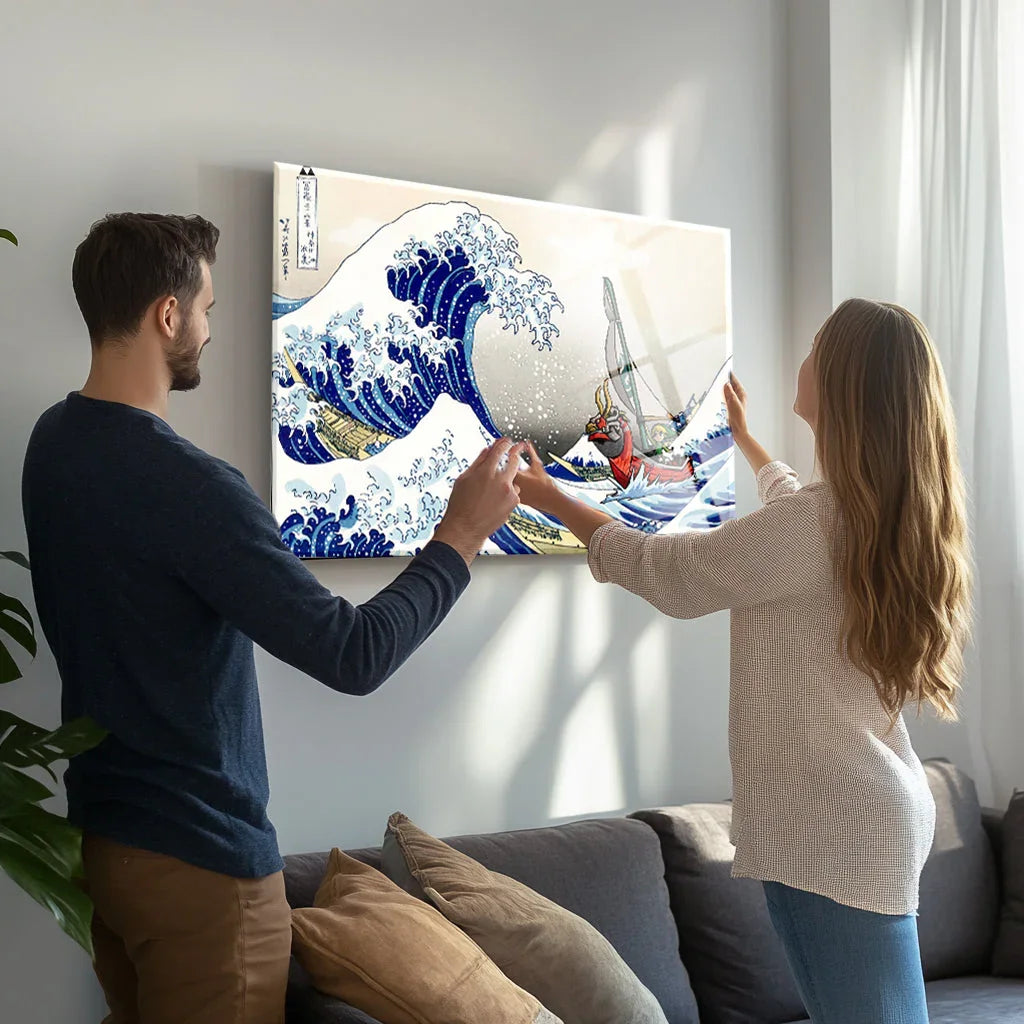
Positioning an oversized Toho Studio cinematic print off-center over a media console creates an asymmetric balance that grounds the room's visual weight far more effectively than strict symmetry. Conventional interior doctrine insists on centering artwork at the mathematical midpoint of a large drywall span. This disconnects the visual mass from the furniture beneath it, leaving an awkward tension in the room. A curated cinematic kaiju artwork collection demands a different approach. You must visually anchor the piece exclusively to the furniture footprint. Japandi aesthetics thrive on fukinsei, the principle of asymmetry and organic balance. Hang an oversized Showa-era graphic so the bottom edge sits precisely 15cm above the credenza surface, locking the mass into a cohesive unit. Shift the frame to the left 60 percent of the console width. Commit fully to this asymmetry, as half-measures register as a hanging mistake. Balance the right side with a raw, unglazed Bizen stoneware vase holding dried birch branches or an Akari 1A paper lamp by Isamu Noguchi. Subverting the rigid symmetry of commercial media rooms lends a curated collector's sensibility that celebrates ma, the Japanese concept of negative space.
Visual ergonomics research consistently demonstrates that compositions occupying two-thirds of the underlying furniture's total width maintain longer focal stability than pieces spanning wider expanses. Prevent cognitive visual crowding. Do this intentionally. The Giant Monster Red Sun Minimalist City Glass Wall Art functions highly effectively here, utilizing its Pantone 186 C crimson focal point to draw the eye downward into the secondary walnut or teak wood tones of your furniture. That saturated red acts as a visual anchor, stopping the eye from wandering endlessly across blank plaster.

The Science of Preserving Archival Pigments
Museum-grade framing materials are non-negotiable to protect delicate CMYK halftone lithographic pigments from degrading under interior ambient lighting. Standard silica float glass exhibits an eight percent light reflectance rate. This creates severe glare under recessed 2700K to 3000K media room lighting, obscuring the artwork and throwing harsh reflections across the room. You must use 99 percent UV-filtering anti-reflective museum glass, specifically Tru Vue Optium Museum Acrylic, which reduces reflectance to under one percent. Using this specialized acrylic preserves the deep charcoal, sepia, and desaturated red tonal gradations of vintage 1968 Mothra canvas pieces or Epson UltraChrome HDX giclee prints without washing out adjacent neutral walls. A singular point of graphic intensity validates the negative space, rather than competing with it. By eliminating the glare, the artwork ceases to act as a mirror and instead becomes a deep, absorbing texture.
Encase the print in an 8cm to 10cm wide, 100 percent cotton rag acid-free 8-ply mat in an off-white warm cream, such as Rising Museum Board. Creating this necessary visual buffer separates high-intensity 1954 to 1975 vintage colorways from quiet Jotun Lady Pure Color Japandi wall paints. Frame the piece in a 20mm-face, 40mm-deep slimline box frame constructed from blackened ash. Match this timber to the secondary wood accents in the room, like the arms of a Herman Miller Eames lounge chair, rather than attempting to match the wall color. The Giant Sea Monster in City, Epic Glass Wall Art demands this level of material respect. Its complex halftone blues and muted cyan ink saturation hold up exceptionally well behind Optium Museum Acrylic. This grounds the composition. Precision in the blackened ash frame restrains the chaotic motion of the print, translating raw pop energy into disciplined architectural geometry.

Cultivating Tension Through Graphic Pop Culture
Introducing saturated Kaiju sci-fi ephemera into a subdued interior creates a deliberate architectural friction that prevents minimalist design from feeling sterile. High-contrast, graphic cultural art functions best as a deliberate counterpoint in quiet spaces. Contrast creates energy. Implementing a single, high-intensity visual disruption validates the surrounding calm; spatial psychology studies demonstrate that contrasting singular graphic focal points increase cognitive resting periods by 45 percent, proving that architectural restraint requires a bold counterpoint. Pairing a dynamic, vintage 1974 MechaGodzilla poster with restrained, textured materials anchors the eye while letting the architecture breathe. Scattering bright pop-art accent colors throughout your soft furnishings is an important mistake. Repeating the saturated reds or oranges of a retro poster in your Kvadrat wool throw pillows, Beni Ouarain rugs, and linen drapery ruins the serene balance of wabi-sabi interiors. It pushes the aesthetic toward juvenile kitsch. Pull only the tertiary, desaturated background pigments into your room. Weave soot black, weathered stone gray, parchment, or muted moss into Hasami porcelain vessels, Pendleton textured wool throws, and slub linen textiles. Let the framed Showa-era monster print stand as the singular vibrant focal point. Nostalgic pop ephemera achieves high design status by prioritizing preservation-grade framing; weighted archival matting and custom timber profiles command respect as collected history.
The sharp contrast of sumi-e graphic black ink against Dinesen bleached Douglas Fir flooring strips a room of its predictability, giving the eye a definitive place to rest.
The texture of a vintage-style graphic plays against the smooth finish of modern Corian or polished concrete surfaces. Reserve vinyl kaiju decals or an oversized monster mural for transient spaces; a refined environment demands framed permanence. A mature home anchors itself with the weight of Optium glass and ebonized walnut timber. This friction defines high-end interiors. Choose a piece like the Monster Clash in Fiery Metropolis, Glass Wall Art. That chaotic composition of towering figures clashing against a stylized skyline forces a dialogue with the clean, linear geometry of your architectural space.

To walk into a room and find nothing but Sherwin-Williams Accessible Beige is to experience an absence of intention. The Giant Monster Rising In City Fog Sci Fi Glass Wall Art provides the exact tension required, masking intense scale beneath a veil of muted Pantone Cool Gray fog tones. It acts as a massive cinematic wall hanging that respects the quiet palette while demanding attention. When a room holds one deliberate visual disruption, the surrounding emptiness ceases to feel vacant and begins to feel purposeful. The quiet of your empty nest gains a distinct voice, anchored by the unexpected weight of a Japanese cultural icon. Embracing this targeted visual disruption validates the surrounding quiet of your home, ensuring your meticulously curated minimalism feels intentional rather than vacant, establishing an enduring visual legacy that elevates the room into a masterclass of tension and restraint for decades to come. Select the right archival piece for your architecture by browsing the complete curated kaiju art collection.