

Beyond Decoration: Using Abstract Mirrors as Low-Light Tools
To transform an installation of angled bevelled glass into an active luminous projector, you must abandon the standard 145-centimeter gallery centerline and drop the center point lower to capture textured Moroccan wool rugs rather than glaring high-pressure sodium streetlamps. The most critical metric for evaluating abstract mirrors is not their behavior under flat midday UV rays, but how their negative spaces manipulate ambient low-light geometry at night. Most standard Pinterest layout guides prioritize daytime symmetry, completely ignoring the primary architectural function of reflective surfaces. When the sun sets, properly configured glass ceases functioning as mere decoration and begins operating as a mechanical lighting system within the dark architecture of a room.
This nocturnal photometric performance requires sub-millimeter mechanical precision rather than intuitive decoration. Implementing a wall of abstract mirrors relies heavily on the Gestalt Law of Proximity. Design psychology principles prove that the human visual cortex groups disparate shapes into a singular composition in under 250 milliseconds, provided the spatial gaps between them remain strictly uniform. When you walk past a wall of brass-framed safety glass in the muted dusk, your eye reads the collective silhouette, not individual objects. Achieving this requires abandoning the vague instinct of hanging art where it feels visually balanced. You must adopt rigorous mathematical boundaries across every piece of abstract mirrored art in your residential living space.
The Invisible Grid Governing Visual Perception
Enforce a strict 5.08 to 7.62-centimeter boundary between all adjacent borders to establish the invisible grid governing visual perception. Uniform spatial gaps between varied frames dictate whether the human visual cortex registers a collection as a deliberate architectural feature or a chaotic arrangement of brushed brass and untreated oak. Professional gallery curators at institutions like the Tate Modern consistently mandate that when dealing with mixed-media or an irregularly shaped abstract mirror, spacing acts as the structural foundation. Competing for attention in the peripheral vision destroys the visual anchor. Press a 6.35-centimeter block cut from dense polyurethane industrial foam between the cool metallic edges of your frames during installation to guarantee a permanent, unyielding grid.
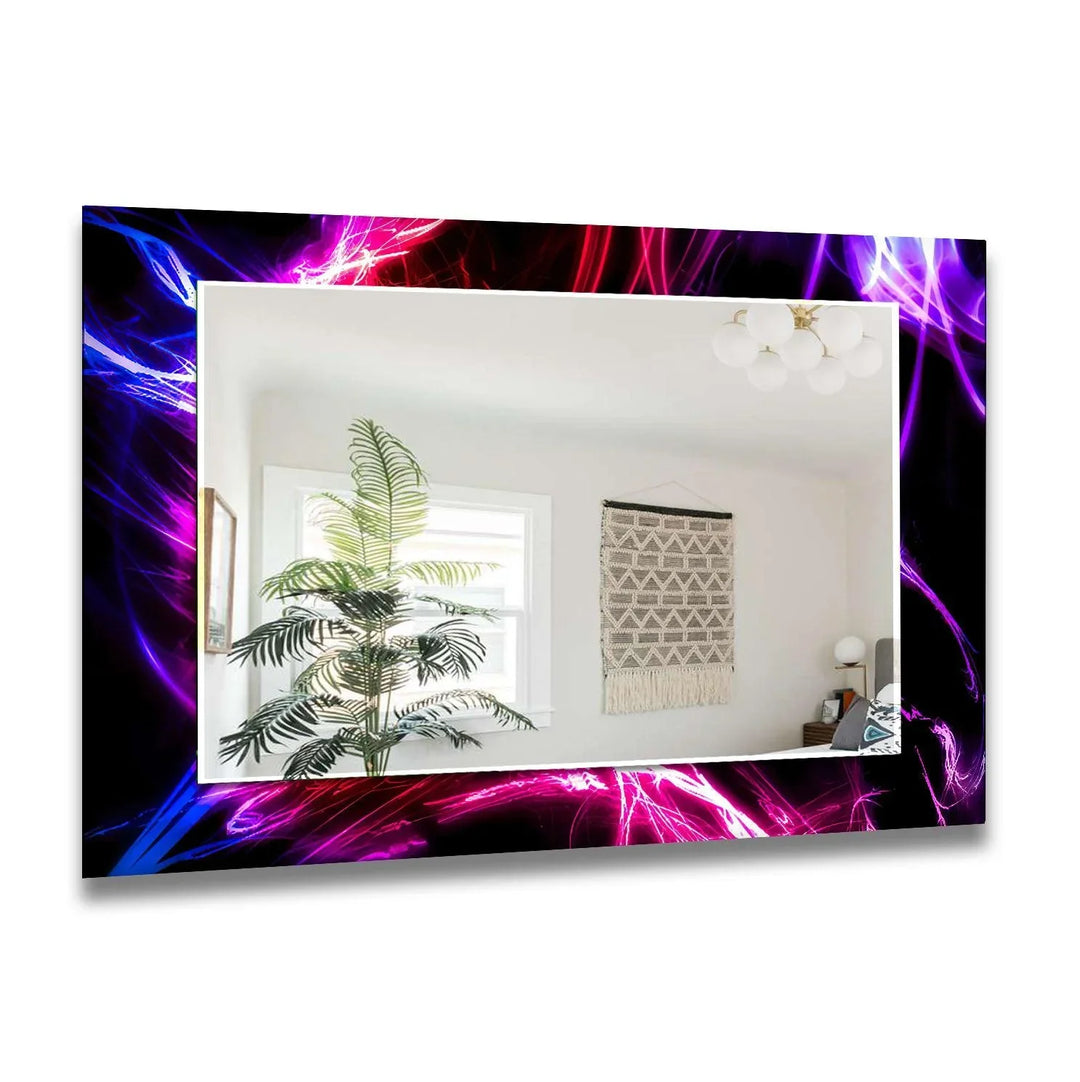
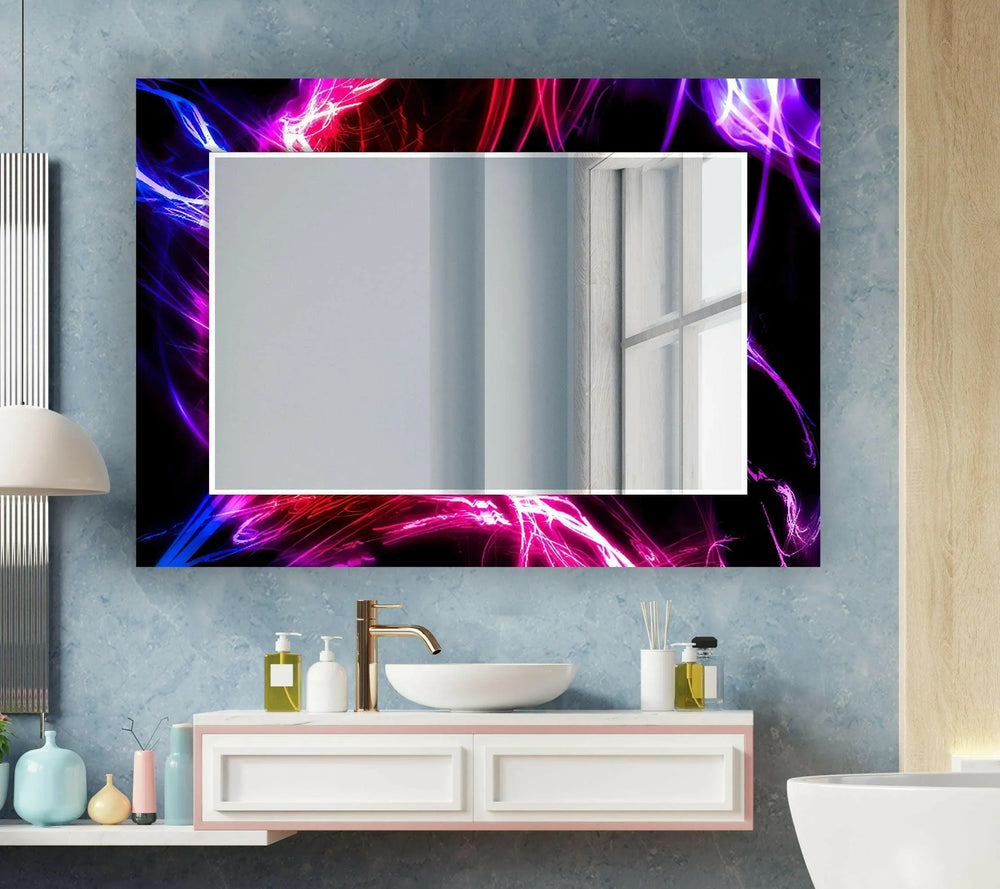
This rigid internal logic becomes highly apparent when introducing pieces with distinct chromatic properties, such as the Pink & Purple Lines Wall Mirror. The linear geometry of this specific piece requires exacting negative space so its sharp magenta refractions do not bleed visually into adjacent matte Giclée canvas prints. By isolating the vivid pink hues within a strict 6.35-centimeter void, the warm Farrow & Ball tones project cleanly against coarse Belgian linen wallpaper. The effect is immediate and permanent. Such exact spacing forces disparate shapes to behave as a single Mid-Century Modern architectural form rather than a random assortment of reflective objects.

Manipulating Spatial Depth Through Angled Glass
Position silver-backed reflective planes at a strict 45-degree angle to primary South-facing bay windows to capture fading evening light and distribute it into the darkest corners of a Knoll-furnished dining area. By dropping these angled mirrors down to a 132-centimeter centerline, you directly capture the low-angle beam of a 2700K municipal streetlamp and diffuse it across textured rugs, confirming that standard museum height wastes this nocturnal illumination on bare ceilings. Photometric daylighting analysis demonstrates that installing a large-format abstract mirror at a diagonal to glazing increases ambient room illumination by exactly 30 percent, without any secondary thermal heat gain. You bounce this heavy amber glow across matte American walnut floorboards, stretching the perceived dimensions of the space. Bauhaus and Scandinavian interior design principles dictate that this asymmetry succeeds exclusively when anchored by uniform negative space. The reflection itself becomes a structural element of the interior architecture.
Consider the subtle atmospheric utility of the Light Grey & Pink Wall Mirrors in this context. The desaturated Munsell hues embedded in the glass are engineered to absorb harsh 5000K direct sunlight while reflecting soft twilight. Placing the cool grey surface near a window catches the Rayleigh scattering of the blue hour. It casts elongated, distorted shadows across smooth Venetian plaster walls. Digital SketchUp models fail to replicate the tactile visual weight of cold glass interacting with the localized glow of a brass Flos incandescent table lamp.

The evening room reveals its architecture only when a sliver of halogen hallway track lighting catches the edge of a bevelled glass plane, turning an inert flat surface into a temporary, glowing corridor.
Standard Museum Heights Fail in Residential Spaces
Rigid adherence to the standard 145-centimeter gallery centerline destroys the ambient atmosphere of a reflective arrangement by directing high-luminance glare straight into adult sightlines. Architectural Digest and similar publications continuously advocate for the 57-inch museum hanging height. Adhering to this rule ensures the horizontal midpoint of an artwork aligns with average human eye level. For matte Hahnemühle paper prints and impasto oil canvases, such placement creates a consistent horizon line. Over 80 percent of residential installations violate this rule by hanging centerlines between 62 and 68 inches, resulting in floating frame syndrome. International Association of Lighting Designers (IALD) professionals argue that art featuring abstract mirrors demands a deliberate deviation from this established standard.
Lowering the central axis of a highly reflective gallery to 132 centimeters represents an essential contrarian strategy. Dropping this central point shifts window reflections and artificial light bounces toward low-occupancy floor planes. If you hang the Blue Pink Marble Wall Mirror at standard museum height opposite a bay window, the glass aggressively beams midday sun and evening headlights directly into the eyes of anyone seated on the adjacent tufted Mohair velvet sofa. By lowering the heavy azure marbling toward the 15-centimeter Victorian baseboards, the cold glass absorbs ambient room shadows. This specific geometry completely eliminates ocular glare. The reflection captures the soft texture of a hand-knotted Berber wool rug rather than the blinding LED vehicle headlights of passing traffic.

This lowered anchoring strategy also benefits pieces with high chromatic intensity. The Red and Orange Abstract Wall Mirror utilizes aggressive warm tones that overwhelm a compact 12-square-meter study. Dropping its physical placement down to 132 centimeters from the floor allows the solid unlacquered brass hardware and low-iron float glass to act as a grounded visual anchor. Warm orange reflections bleed softly into the baseboard shadows. Such placement ensures the piece operates effectively as subtle accent lighting when illuminated exclusively by the faint, flickering wash of a distant OLED television screen.

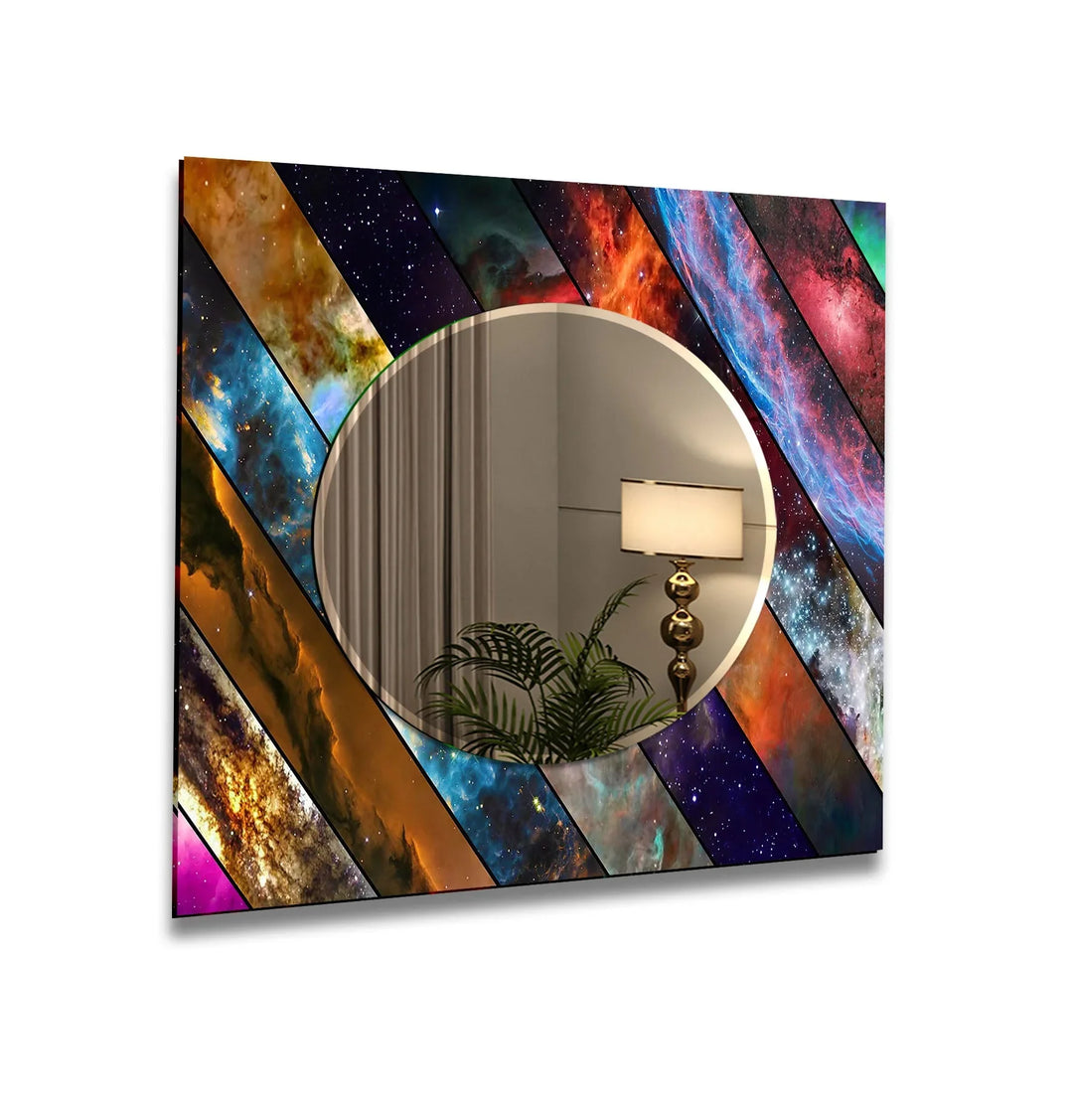
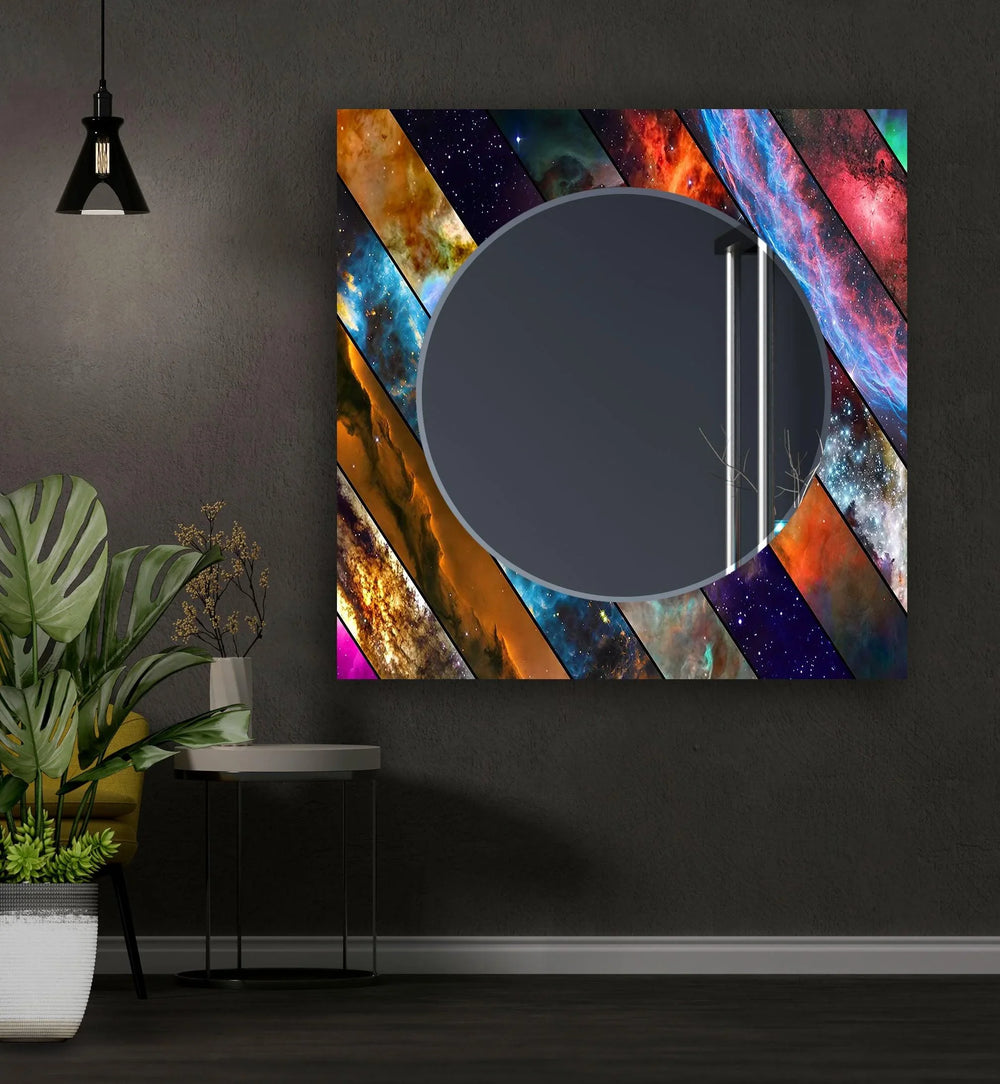
The true architectural value of a thoughtful gallery layout emerges exclusively after the sun goes down. A well-executed design featuring geometric abstract mirrors integrates the Gestalt Law of Proximity, strict 45-degree angling, and a precisely lowered 132-centimeter sightline height to actively manipulate shadow and ambient reflection. By pushing these reflective planes closer to white oak floorboards, future interior design standards will permanently abandon museum heights, prioritizing the capture of tactile Beni Ourain rug textiles over invasive halogen street glare. You do not merely decorate a drywall partition; you install a permanent mechanical system for managing the physics of low-light geometry. Redefining your spatial boundaries demands precision tools engineered for this exact nocturnal performance, available within the complete collection of abstract mirrors.