

The Horizon Effect: Lowering Panoramic Lake Photography in Narrow Hallways
By dropping a panoramic lake photograph ten centimeters below the standard 145-centimeter sightline to a 135-centimeter centerline, you create a high-prospect viewing angle that acts as a psychological release valve in narrow hallways. Engineering this hallway's cognitive horizon turns a claustrophobic transit zone into an expansive space. When you check into the Aman Kyoto or the Four Seasons Geneva, the framed cyan and deep cobalt Munsell 10BG water landscapes hanging in the corridors serve as deliberate visual anchors rather than aesthetic pleasantry. A carefully calibrated panoramic water scene printed on 300gsm archival cotton paper provides immediate mental relief. The hotel corridor feels restful because commercial spatial designers understand the weight of tight architecture. Your residential passageway feels restless because it lacks an optical escape. Humans move through these narrow architectural arteries dozens of times a day, and our autonomic nervous systems react to the proximity of gypsum plasterboard. Large aquatic architectural photography opens the architecture of your home from the inside out.
Walk through the famously narrow corridors of the Aman Tokyo. The designers placed wide 3:1 aspect ratio nature photography printed on Hahnemühle acid-free archival paper along the 1.2-meter-wide passageways. This precise choice mirrors environmental psychology principles. Viewers experience panoramic lake landscapes as a horizon line. This horizontal orientation stretches the perceived width of the architecture. The human visual cortex interprets the two-dimensional water surface as genuine physical depth. This functions as applied biophilic design. Narrow residential spaces generate low-grade psychological friction, where standard drywall presses inward. Providing an uninterrupted view of a distant alpine shore forces a cognitive override, instantly reducing physical tension.
Why Prospect-Refuge Theory Dictates Horizontal Alignment
British geographer Jay Appleton formulated Prospect-Refuge Theory in 1975 to explain this exact spatial dynamic. Human evolutionary psychology demands a broad visual field to feel secure in constricted physical environments. Humans find aesthetic pleasure in environments where they see without being seen. A typical 90-centimeter residential corridor acts as the protective enclosure. A 120-centimeter wide museum-grade landscape print acts as the expansive prospect. Hanging vertically oriented portraits in a narrow hallway compresses the horizontal plane. Such placement turns the space into a claustrophobic crevice. Using a wide 2:1 or 3:1 aspect ratio canvas creates a subconscious visual draft. That visual draft pulls the eye along the corridor, simulating open terrain like the Scottish Highlands. Evolutionary biology wires humans to seek the horizon. When confining the human body in a passageway measuring less than 120 centimeters across, the absence of a distant focus point triggers a sympathetic nervous system alarm state. A horizontal aquatic landscape print neutralizes the spatial alarm. It gives the eye a distant vanishing point on a depicted Lake Geneva water's edge.
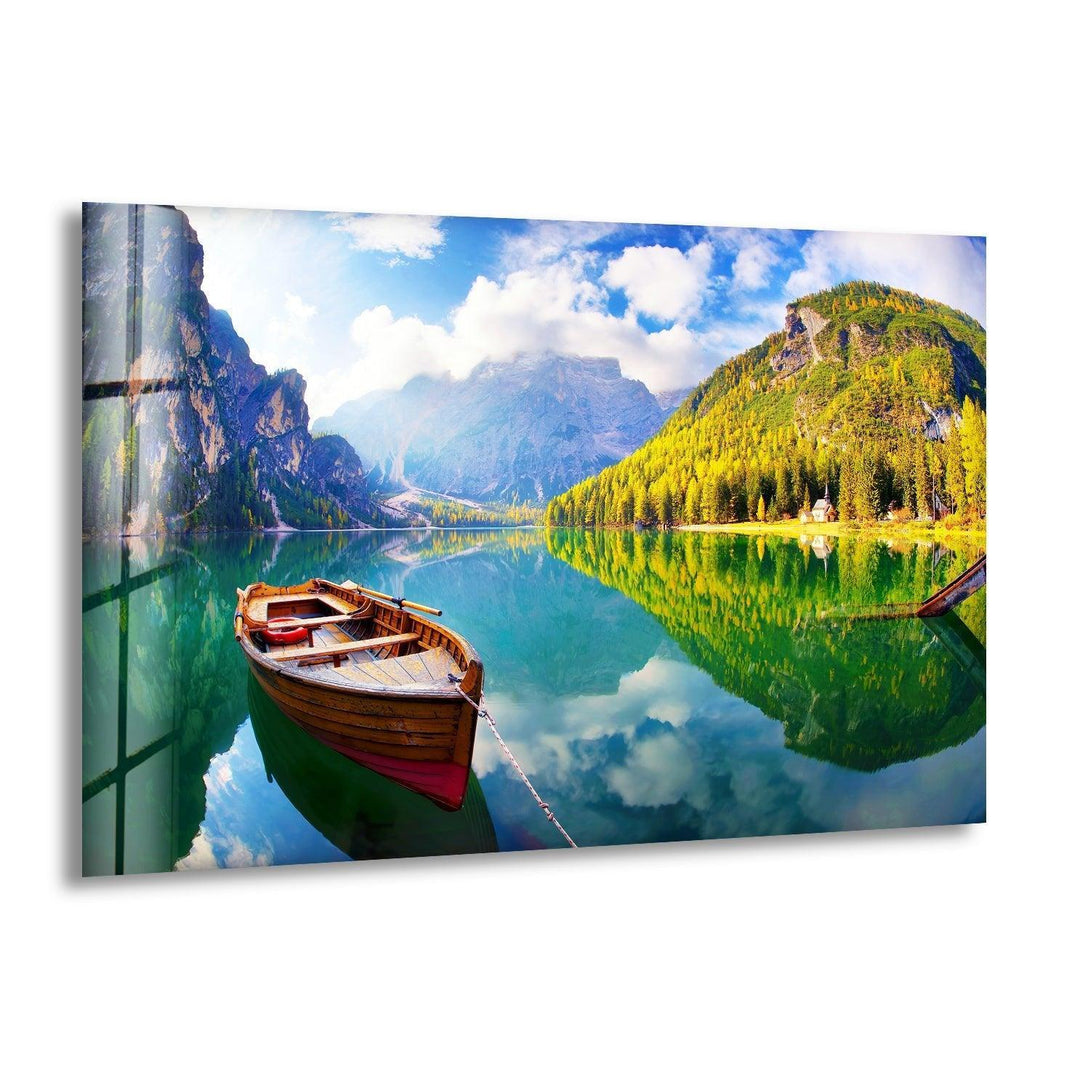
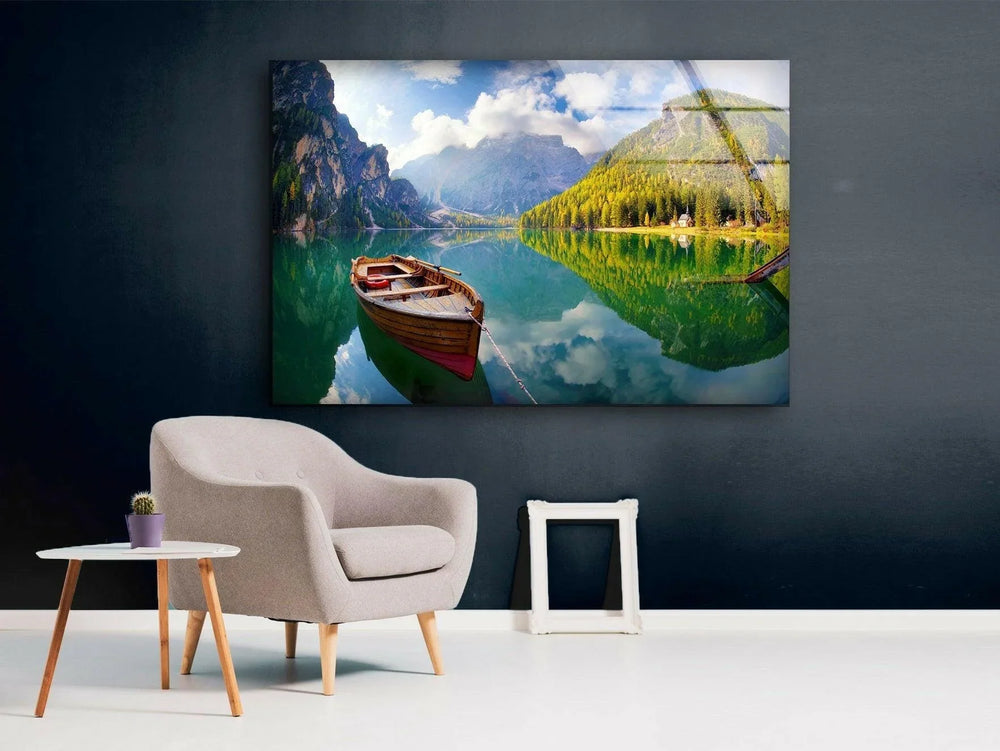
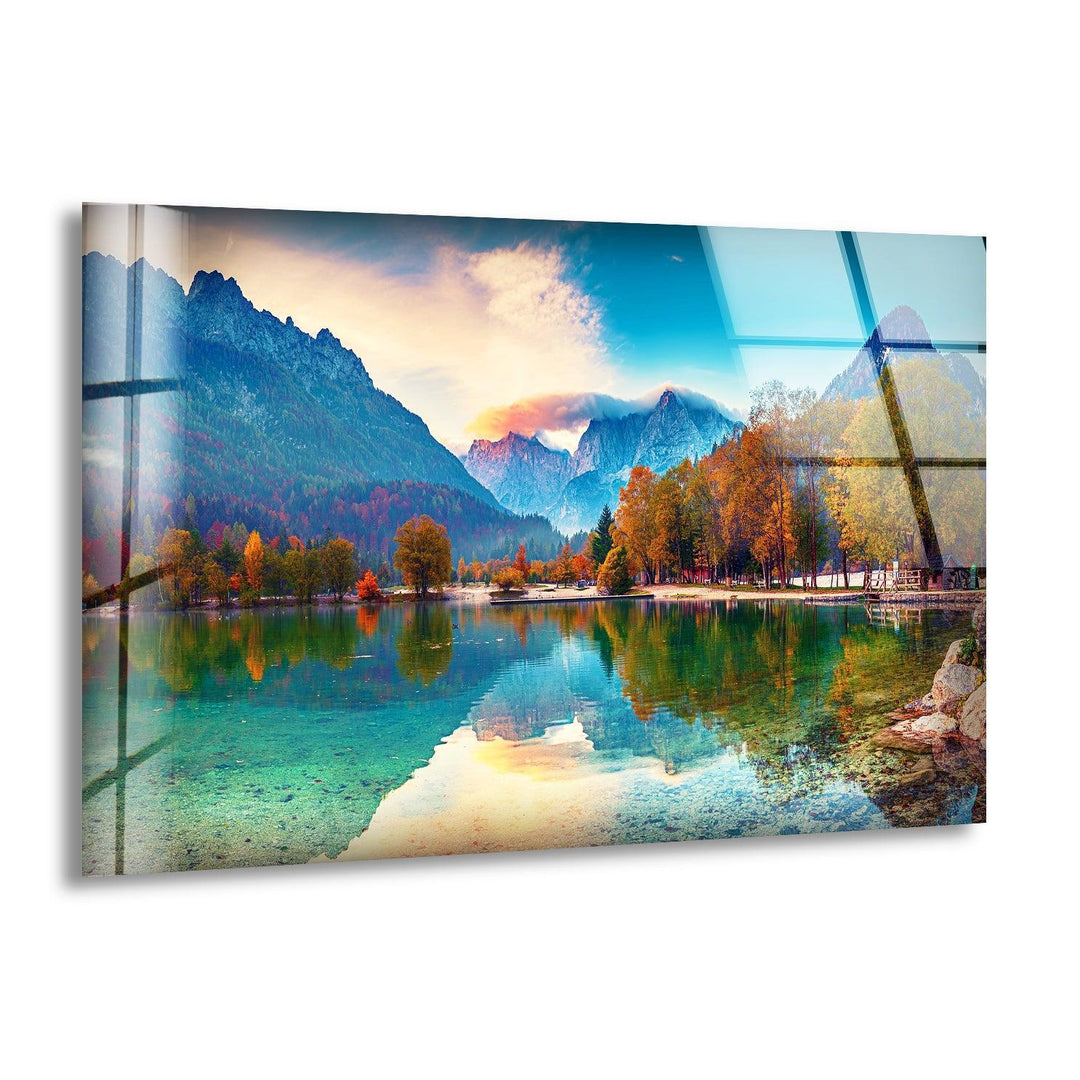
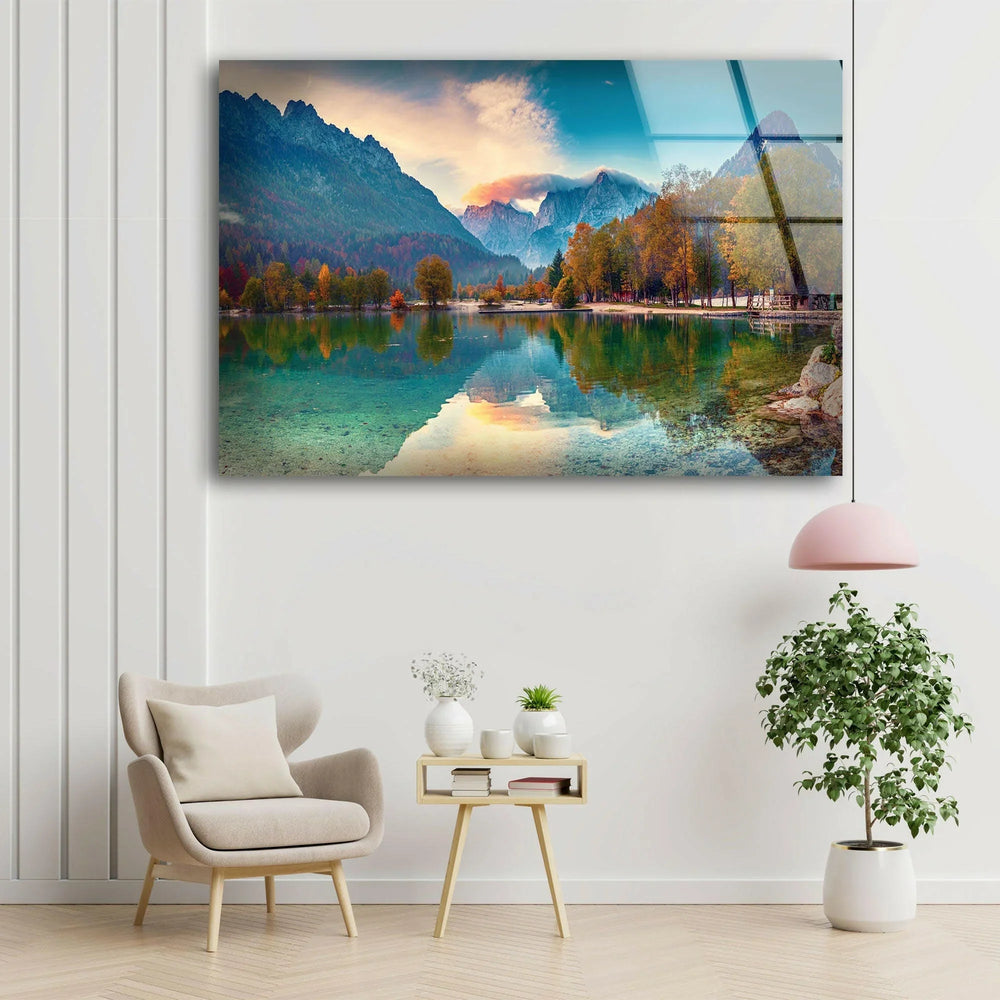
The Lake, Trees and Mountain Nature Landscape Glass Wall Art functions precisely under these parameters. Its wide 3:1 horizontal visual plane forces the optic nerve to scan laterally across the depicted Swiss Alps ridge. That lateral eye movement mimics scanning a physical horizon. It actively suppresses the sympathetic nervous system response triggered by tight domestic spaces. Continuous Pantone 3415 C emerald tree lines provide a measurable scale for the visual cortex to process distance.

Water Imagery Lowers Physiological Stress Markers Instantly
Clinical studies of interior spaces consistently demonstrate that viewing depicted aquatic environments lowers salivary cortisol and blood pressure compared to blank plasterboard walls. Visual exposure to aquatic environments reduces systemic anxiety within seconds of observation. Attention Restoration Theory establishes that micro-restorative natural scenes allow the prefrontal cortex to recover from directed attention fatigue rapidly. Lake scenes serve as cognitive anchors. You pass them in a fraction of a minute. That brief exposure initiates physiological recovery. Dropping these panoramic lake photographs ten centimeters below the standard sightline to a 135-centimeter centerline forces a high-prospect viewing angle, accelerating this physiological recovery. Placing these 120-centimeter pieces near oak-framed doorways ensures maximum impact. Humans respond to the specific spectral wavelengths of blue and green water imagery. The optic nerve transmits these Munsell 10BG wavelengths directly to the amygdala. Such transmission signals an environment rich in life-sustaining resources. Modern minimalist interiors strip these biological cues away. Replacing them with framed waterfront photography on archival cotton paper sets a biological baseline for calm.
Consider the visual mechanics of the Sunrise On Calm Lake Glass Wall Art. The specific desaturated cerulean and amber wavelengths captured in the depicted sunrise act as natural chromotherapy. Environmental psychology research confirms that still water bodies signal resource-rich tranquility. This exact giclée print activates that biological preference. Soft morning light represented on the tempered glass surface softens the rigid gypsum geometry of standard 1.2-meter-wide passageways.

The Mathematical Precision Of Sensory Crowding Prevention
Maintaining a frame-to-wall square footage ratio between 30 and 40 percent noticeably increases the perceived spatial volume of a narrow passage. Art exceeding 40 percent of a corridor's vertical surface area triggers spatial anxiety instead of relief. Spatial cognitive research reveals a strict threshold for sensory crowding in corridors narrower than 1.2 meters. Designers calculate the exact canvas area. Multiply the total wall length by the 0.57 Golden Ratio derivative to determine the optimal panoramic frame width. A standard 2.4-meter by 3-meter plasterboard wall requires a matte canvas giclée capped precisely between 2.16 and 2.88 square meters. Leaving clear margins of negative space around the untreated oak frame prevents the installation from reading as a physical obstruction. The visual cortex requires blank Benjamin Moore Chantilly Lace white or grey wall space to process the visual data of the landscape. Overfilling the drywall cancels the expansive effect.
The minimalist composition of the Swan Lake View Glass Wall Art maximizes this negative space ratio. Its vast expanses of pale ivory and slate blue water prevent visual clutter while introducing necessary depth. A low-saturation palette receding into the distance mimics atmospheric perspective perfectly. Darker foreground objects like the depicted shoreline reeds appear closer, whereas lighter background mist tones recede. This optical physics trick pushes the physical drywall boundary outward.

Challenging Conventional Eye-Level Installation Rules
Dropping a landscape giclée print ten centimeters below the standard sightline maximizes the illusion of spatial release. Conventional interior design rules strictly dictate hanging frames at a 145-centimeter center-point to match a standing adult. Hanging panoramic lake photography intentionally lowered at a 135-centimeter centerline creates a superior spatial illusion. That lowered position mimics the evolutionary experience of standing on an elevated shoreline looking down at a freshwater source. It creates a high-prospect and low-foreground orientation. Hanging a canvas at standard eye-level in a tight space forces a flat, 90-degree visual confrontation. Such direct alignment reminds the visual cortex of the physical wall's proximity. Lowering the piece turns the transit zone into a psychological release valve. The downward angle tricks the mind into perceiving a vast horizon rather than a proximate barrier. When looking slightly downward into a depicted alpine valley or lake basin, the physical constraints of the hallway vanish. The viewer observes a vast vista rather than a confined corridor.
Applying this 135-centimeter lower installation height to the Lake Under Sunset Pier Glass Wall Art completely changes its spatial impact. The viewer physically looks down onto the depicted illuminated teak wood pier. That subtle downward gaze deepens the prospect effect exponentially. It forces a physical posture of relaxation, actively drawing the trapezius muscles and shoulders down.

How Surface Glazing Dictates Spatial Perception
Specifying museum-grade anti-reflective acrylic or a non-reflective satin varnish prevents the break in visual perception caused by glare. Reflective glass finishes destroy the cognitive illusion of natural depth in tightly confined domestic spaces. Passageways frequently rely on harsh 4000K recessed overhead LED spotlights and feature tight viewing angles. Using standard float glass glazing or high-gloss polyurethane varnishes creates aggressive glare. Such glare breaks the immersive quality of the landscape. It forces the optic nerve to focus on the physical surface plane of the print rather than the depicted distant horizon. That optical conflict causes rapid visual fatigue. The surface of the piece must disappear entirely. Only the image remains. When light bounces off a glossy frame in a 1.2-meter narrow corridor, the artwork becomes a mirror reflecting the opposite drywall. The viewer loses the depicted water entirely.
Selecting pieces for the narrowest parts of residential architecture requires strict scientific calculation. Incorporating waterscape photography into master bedroom vestibules and narrow hallway corridors is never a decorative afterthought. It acts as an important cognitive release valve, converting a claustrophobic transit zone into an expansive horizon. By deliberately lowering these panoramic lake photographs ten centimeters below the standard sightline to a 135-centimeter centerline, you create a high-prospect viewing angle that acts as a psychological release valve. This single ergonomic adjustment permanently transforms domestic architecture, ensuring daily hallway navigation reduces cortisol accumulation rather than compounding it. When applying precise installation metrics and Prospect-Refuge evolutionary design principles, a simple corridor becomes a restorative journey. The depicted shoreline provides a continuous optical escape route for the overstimulated mind. To begin engineering a better psychological flow through your home's tightest transit areas, review our curated panoramic lake collection.