

Planificación presupuestaria: El elemento que falta en el arte mural solar
El verdadero estilismo de interiores de alta gama requiere un enfoque poco convencional para la planificación del presupuesto: asignar el 60 por ciento de los fondos a la enmarcación para la conservación de archivos, no a la obra de arte en sí. Una litografía botánica de 50 dólares enmarcada en un marco de conservación de roble americano macizo de 200 dólares tiene mucha más autoridad arquitectónica que un lienzo estirado de Breathing Color de 500 dólares colgado sin marco. Establecer esta estricta proporción financiera de 60/40 garantiza que cualquier arte mural del sol La pieza domina estructuralmente la habitación.
Invertir las reglas del sustrato define la calidad espacial.
Colocar una impresión mate de 230 g/m² ultrasuave y montada sobre una superficie de ladrillo visto de Chicago con mucha textura o un estuco veneciano irregular le confiere a la obra una calidad gráfica nítida y personalizada. El diseño de interiores de alta gama se basa en la tensión de los materiales, específicamente en el contraste entre las texturas arquitectónicas en bruto y las superficies artísticas excepcionalmente lisas. El instinto del consumidor tiende a imprimir vectores geométricos minimalistas sobre lienzo texturizado. Ese enfoque es un error. foto en lienzo Dominan el 45,11 por ciento del mercado mundial de arte mural bajo demanda, pero imprimir arte plano y minimalista en material rugoso produce una apariencia genérica que recuerda a la puesta en escena corporativa de bajo presupuesto. Las texturas tejidas interrumpen activamente las geometrías definidas de los diseños minimalistas. Debes aplicar el principio del sustrato invertido. Imprime un vector de sol de mediados de siglo en tonos mostaza y óxido sobre papel mate liso de 230 g/m². Los materiales planos absorben uniformemente las tintas Greenguard Gold con certificación UL, lo que da como resultado campos de color muy saturados, con un acabado aterciopelado y bordes nítidos.
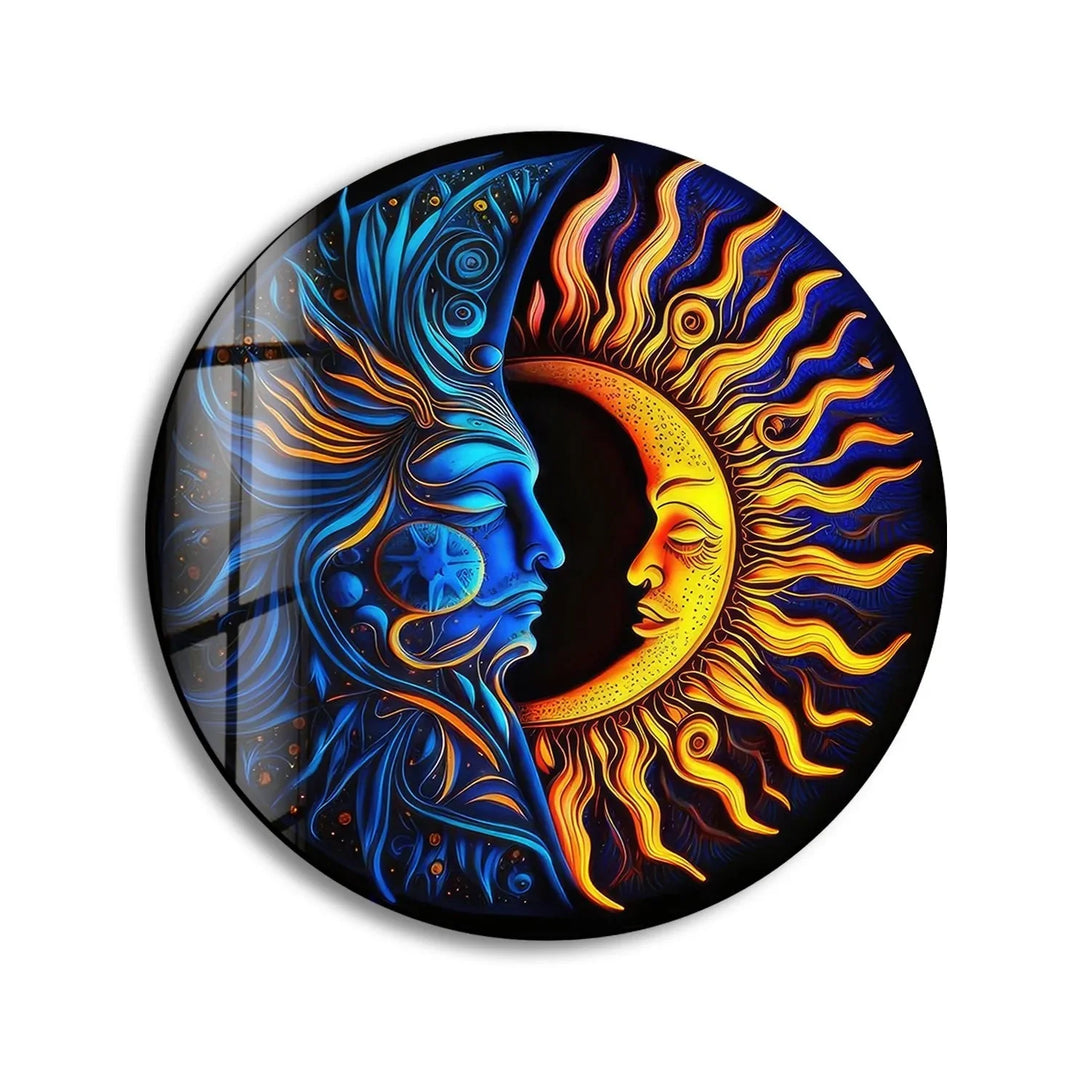
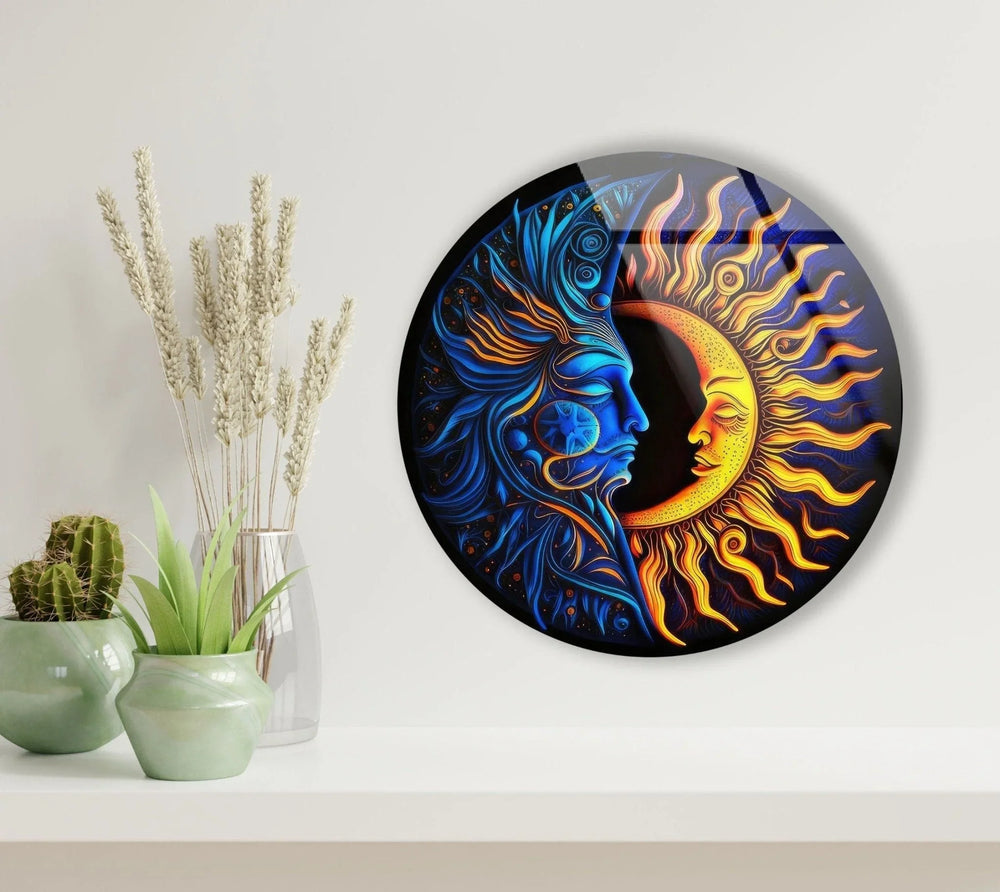
El Sol y Luna teñidos Arte En Vidrio Para Pared Proporciona una superficie de vidrio templado de 3 mm, severa, inflexible e intrínsecamente plana, que actúa como contrapunto estructural a los muebles tapizados. Colocar este material rígido y de alto brillo cerca de sillones de bouclé tejido o aparadores de nogal acanalado crea una separación visual deliberada, denotando una intención arquitectónica de alta gama en lugar de un simple añadido decorativo.

Coloca obras de arte planas y de textura suave contra paredes arquitectónicas con mucha textura para forzar una separación visual inmediata.
Las matemáticas detrás de la fijación de precios de sustratos por pulgada cuadrada
Desviar fondos del margen de beneficio del 140 por ciento del lienzo a nuestra asignación financiera recomendada del 60 por ciento para el enmarcado de conservación de archivo garantiza que la pieza sobreviva de 80 a 100 años. Evaluar el costo por pulgada cuadrada de diferentes sustratos revela que la producción estándar de lienzo tiene un margen de beneficio agresivo del 140 por ciento sobre el papel de archivo superior. Un lienzo estirado estándar de 24x36 pulgadas que utiliza Breathing Color Lyve Canvas tiene un costo de producción base de aproximadamente $51.84, lo que resulta en una tasa de $0.060 por pulgada cuadrada. Una impresión de archivo sin enmarcar en papel mate Hahnemühle de 230 g/m² reduce ese costo base a $21.60, lo que produce una tasa de $0.025 por pulgada cuadrada. Esta métrica exige presupuestos estrictos para el enmarcado. Los pósteres estándar a base de tinte se decoloran o cambian de color en 3 a 5 años bajo la luz solar ambiental normal. Las pruebas de conservación independientes demuestran que las impresiones giclée que utilizan tintas pigmentadas de archivo Epson UltraChrome de 12 colores sobre papel de algodón libre de ácido ofrecen una durabilidad del color de entre 80 y más de 100 años.
El abastecimiento de materiales pesados altera ligeramente el cálculo, por eso una pieza como la Pájaros al atardecer Decoración De Pared Metal Requiere una planificación estructural diferente. La construcción metálica utiliza aluminio Dibond de 3 mm para resistir completamente la humedad ambiental. Esta durabilidad lo convierte en una opción muy eficaz para instalaciones exteriores con motivos solares, puntos focales en los límites del jardín o elementos metálicos que simulan el sol en entornos costeros con alta humedad, como un patio frente al mar en Florida.

Para determinar si está pagando un precio de venta al público total por la superficie en pulgadas cuadradas de la obra de arte, divida el precio total de venta entre la superficie en pulgadas cuadradas de la obra.
Comprender la relación entre el marco financiero y la impresión
Asignar el 60 por ciento de su presupuesto total a la preservación estructural y el 40 por ciento a la impresión en sí garantiza una presentación de calidad de galería, eliminando los elevados costos de enmarcado personalizado. Un proyecto de enmarcado personalizado para una impresión estándar de 24x36 pulgadas en una tienda local como Michaels o Framebridge tiene un costo promedio de entre $250 y $363. Usted evita este gasto por completo comprando marcos de alta calidad, producidos en masa, con paspartús precortados y removibles libres de ácido Crescent Select, lo que genera un ahorro promedio de entre el 80 y el 85 por ciento. Los estándares profesionales de enmarcado advierten explícitamente contra el uso de montajes de cartón de baja calidad, señalando que causa quemaduras irreversibles en el paspartú y amarilleamiento ácido. Las pinturas solares sobre papel requieren un enmarcado protector de alfacelulosa. Implementar la proporción 60/40 con un presupuesto fijo de $150 requiere una estricta adherencia a la asignación de materiales.
- Adquiera la impresión de 24x36 pulgadas en papel Epson Enhanced Matte de 230 g/m² por $45.00, utilizando el 30 por ciento del presupuesto total.
- Adquiera un robusto marco prefabricado de roble americano macizo de 24x36 pulgadas en un distribuidor especializado como Nielsen Bainbridge por 65,00 dólares.
- Sustituya el cristal barato de fábrica por una lámina de acrílico transparente Tru Vue Conservation Clear de 40 dólares para bloquear el 99 por ciento de los rayos UV.
El Pixel Galaxy Arte En Vidrio Para Pared Elimina la necesidad de un acristalamiento acrílico adicional. El vidrio Starphire impreso de bajo contenido en hierro funciona como sustrato y capa protectora. Esta estructura autónoma optimiza el presupuesto de una sala de estar amueblada por Herman Miller al integrar las capas de impresión y conservación en un solo objeto.

Adquiera un marco de madera maciza prefabricado con paspartú extraíble y precortado, y cambie el cristal de fábrica por acrílico con filtro UV.
El soporte rígido evita la inevitable deformación de las fibras.
Debes montar la impresión en seco o asegurarla al ras contra un panel de respaldo Gatorboard rígido y libre de ácido usando esquinas de montaje de archivo profesionales Lineco. Colocar una impresión de papel de gran formato directamente en un marco de póster sin respaldo estructural garantiza una deformación permanente del papel en doce meses. Una pieza de 24x36 pulgadas representa una enorme extensión de papel. La humedad ambiental hace que las fibras de una hoja de 230 g/m² se expandan y contraigan de manera desigual, creando ondulaciones y pliegues antiestéticos. El control del deslumbramiento requiere la misma atención. El arte boho moderno de mediados de siglo se basa en tonos tierra cálidos y desaturados como terracota, verde salvia y ocre. Enmarcar estos tonos de bajo contraste bajo vidrio brillante estándar causa un deslumbramiento severo, haciendo que el diseño sea invisible desde ángulos oblicuos. Siempre combina las impresiones en papel mate con acrílico Optium Museum o acrílico antideslumbrante.
Observe la importancia del contraste en el Tierra azul y amanecer lunar Arte En Vidrio Para ParedLa marcada transición de los profundos azules celestes Pantone 296 C a los brillantes tonos solares proporciona un fuerte anclaje visual. Los diseños de alto contraste toleran mejor las variaciones de luz, funcionando bien en un ambiente más tenue en la habitación de un bebé o en una habitación infantil con iluminación moderada pintada con Sherwin-Williams Alabaster.

Fije las impresiones de gran formato al ras de un soporte de Gatorboard libre de ácido utilizando esquinas de montaje profesionales antes de sellar el marco.
Fórmulas matemáticas precisas para la colocación de muros
Debes instalar la obra de arte de manera que su centro quede exactamente a 145-152 cm del suelo. Establecer relaciones dimensionales precisas entre la obra y la arquitectura circundante da solidez a la sala y evita la fatiga visual. Colgar arte requiere fórmulas numéricas estrictas, no intuición. Esta medida representa la altura estándar de los ojos de un adulto de pie, ampliamente utilizada en las instalaciones profesionales de las galerías Guggenheim y MoMA. Al colocar una pieza enmarcada sobre una credenza Knoll o una consola George Nelson, aplica la regla de los dos tercios de ancho. El ancho del marco debe medir exactamente entre dos tercios y tres cuartos del ancho total del mueble que se encuentra debajo. Finalmente, deja exactamente entre 15 y 25 cm de espacio negativo entre la parte superior del mueble y la parte inferior del marco Nielsen Bainbridge. Este espacio preciso actúa como un anclaje invisible, uniendo la obra de arte al mueble en lugar de dejar que flote sin rumbo hacia el techo.
Invertir la jerarquía de gastos para asignar exactamente el 60 por ciento de su presupuesto a un marco de conservación robusto, en lugar del soporte de impresión, garantiza que su instalación domine la sala durante décadas. Concentrar sus recursos en Gatorboard libre de ácido, roble americano macizo y acrílico transparente de conservación Tru Vue crea un ancla visual inamovible. Ya sea que esté realizando una instalación solar de madera de abedul o una pared de galería minimalista, esta precisa asignación financiera 60/40 define la calidad espacial final. Su espacio arquitectónico específico adquiere autoridad inmediata cuando aplica estas rígidas fórmulas estructurales a nuestra selección de obras. arte mural del sol colecciones.