

Pourquoi votre bureau à domicile est un échec sans une décoration murale stratégiquement choisie
Le contexte architectural de votre espace de travail détermine si un motif visuel spécifique apaise la fatigue mentale ou, au contraire, aggrave le stress physiologique. La géométrie euclidienne de l'environnement modifie profondément la façon dont votre cortex visuel traite les silhouettes naturelles. Ainsi, une œuvre d'art biophilique organique, placée dans une pièce minimaliste aux lignes droites et stériles, provoque des difficultés cognitives au lieu de réduire le stress. Une toile Hahnemühle de 120 x 80 cm représentant une dense forêt de pins bavaroise, qui induisait un calme immédiat lors d'un séjour dans une suite de luxe du Ritz-Carlton, engendre une profonde agitation lorsqu'elle est accrochée au-dessus d'un bureau assis-debout Herman Miller standard. Cette différence s'explique par le fait qu'une suite hôtelière utilise un design spatial doux et fluide, propice à l'intégration d'images biophiliques organiques, tandis que l'espace de travail typique d'un bureau à domicile est dominé par une géométrie rigide aux lignes droites. Ne blâmez pas l'œuvre d'art. Sélectionner objets décoratifs pour vos murs Cela reste un calcul à haut risque de neurologie cognitive et d'architecture spatiale.
La physiologie de la complexité visuelle explique votre fatigue de l'après-midi
L'observation de fractales statistiques biophiliques d'une complexité moyenne réduit directement le stress physiologique jusqu'à 60 % en moins d'une minute. Le physicien Richard Taylor, de l'Université de l'Oregon, a établi le concept de fluidité fractale grâce à des décennies d'expériences sur la perception visuelle. L'évolution a programmé la rétine humaine pour traiter le langage visuel de la nature avec une extrême efficacité. Ce traitement visuel rapide crée une expérience esthétique accompagnée d'une diminution objective de l'activation du système nerveux sympathique et de la tension musculo-squelettique. Les conditions optimales pour cette réaction biologique se situent précisément entre une dimension fractale D = 1, 3 et D = 1, 5. Un enregistrement électroencéphalographique (EEG) continu prouve que l'observation de silhouettes biophiliques naturelles à D = 1, 32 déclenche une augmentation massive de 44 % de la puissance des ondes alpha dans le cortex préfrontal. L'augmentation de l'activité alpha induit un état neurologique de relaxation éveillée nécessaire à la résolution créative de problèmes, tandis qu'une forte puissance bêta dans le lobe pariétal maintient simultanément l'attention active.
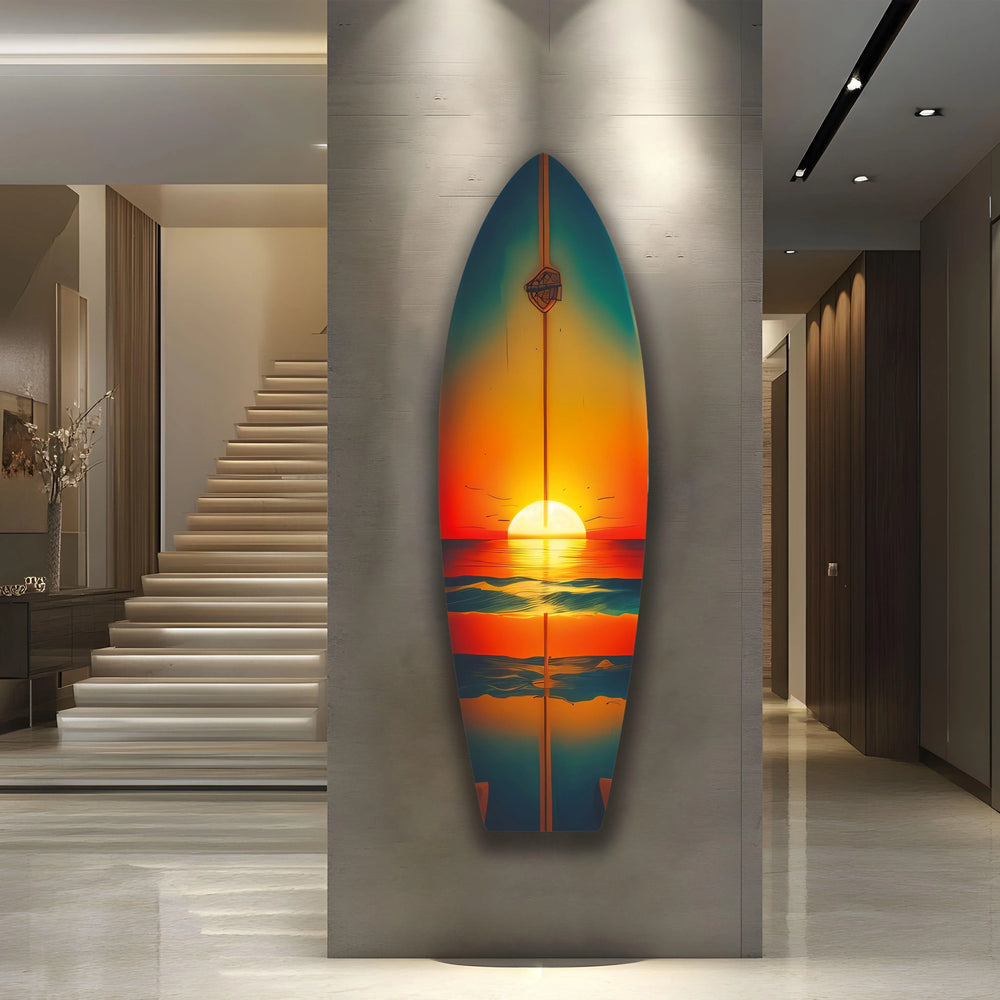
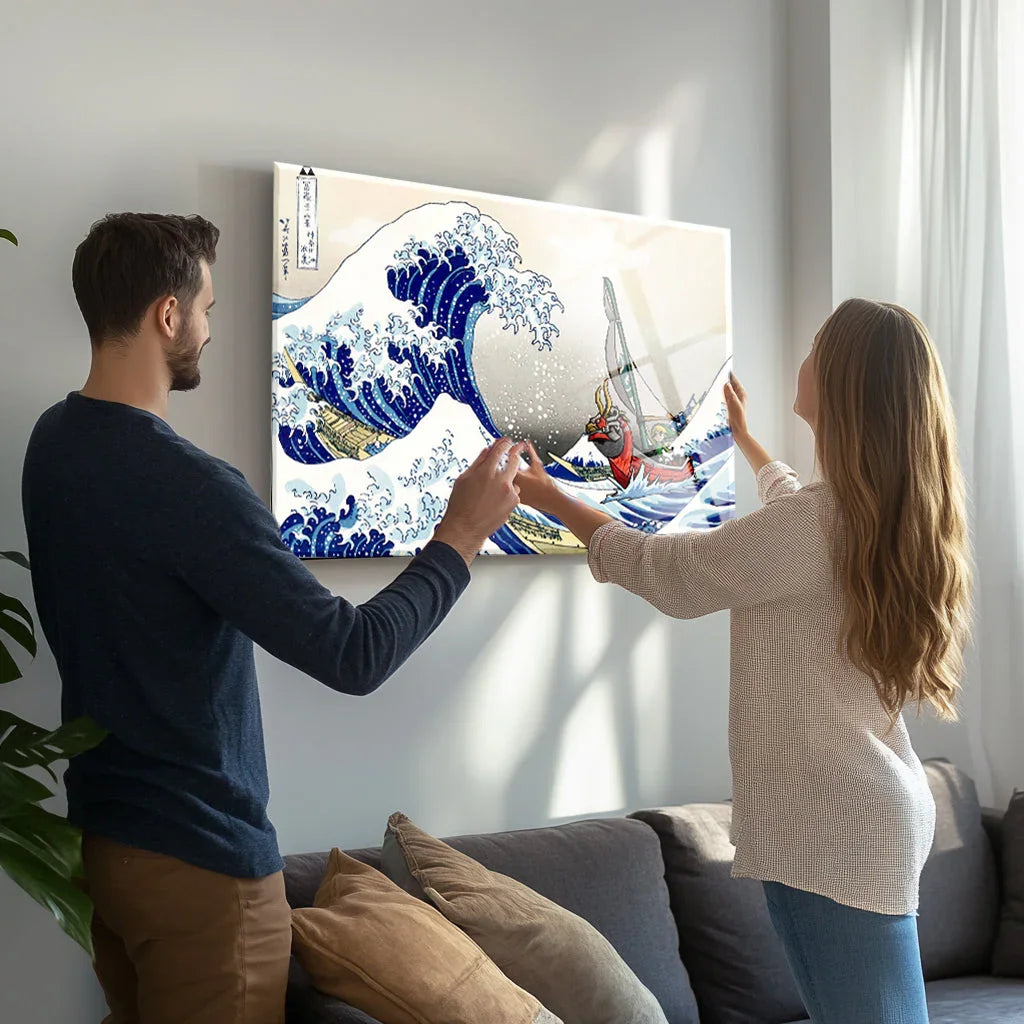
Les estampes japonaises traditionnelles Ukiyo-e de l'époque d'Edo atteignent naturellement cette dimension fractale précise, ce qui explique leur attrait universel et durable. La rétine humaine suit sans effort l'épaisseur spécifique des traits de Katsushika Hokusai. Lorsqu'elles sont rendues dans des tons bleu-vert désaturés, notamment la teinte Munsell 10BG, le système nerveux parasympathique s'active rapidement. Les préférences abstraites obéissent aux mêmes règles. Les peintures par égouttement de Jackson Pollock, réalisées au milieu de sa carrière en 1945, comme « Mural » , présentent un D = 1, 3 apaisant, procurant un réconfort visuel immédiat. Ses compositions denses de la fin de sa carrière dépassent un D = 1, 8 chaotique, engendrant une forte fatigue visuelle. Commencez par une œuvre avec un D = 1, 3 pour éviter la fatigue des écrans numériques. Une œuvre comme… Art mural estival tropical sur planche de surf Cela fonctionne précisément parce que les vagues organiques de l'océan Pacifique et les silhouettes tropicales hawaïennes irrégulières s'inscrivent dans cette dimension réparatrice de moyenne gamme. Votre cortex visuel traite les images sans dépenser d'énergie métabolique excessive.

Comment la photographie botanique dense sabote la mise au point
L'évaluation d'un tableau pour un espace de travail nécessite l'analyse de sa densité visuelle mathématique plutôt que de son sujet. Les représentations très détaillées d'une nature dense surstimulent le cortex visuel et aggravent directement la fatigue cognitive. Supposer que l'ajout d'éléments biophiliques favorise intrinsèquement la récupération mentale demeure une erreur fréquente en conception architecturale. Des recherches publiées dans le Journal of Environmental Psychology, revue à comité de lecture, confirment que le cerveau humain privilégie les motifs visuels intégrant une forte part d'aléatoire organique, associée à des dimensions fractales faibles à moyennes (D = 1, 3 à 1, 4) . Ces rapports mathématiques précis déclenchent une douce fascination, principal mécanisme cognitif nécessaire à la guérison de la fatigue mentale. La fatigue d'attention dirigée (FAD) se manifeste physiquement par de légers maux de tête frontaux, de l'irritabilité et une difficulté à filtrer les bruits ambiants. Les gros plans macro à fort grossissement de feuillage de Monstera ou les photographies de la dense forêt amazonienne présentent une dimension fractale élevée (D = 1) . 7 à 1, 9. Ces motifs complexes présentent un bruit visuel extrême à la rétine, nécessitant une attention active et dirigée pour être traités et épuisant continuellement vos réserves cognitives quotidiennes.
Les éléments synthétiques comme les plantes grimpantes en polyéthylène ou les compositions d'orchidées en polyuréthane à fort contraste n'offrent pas de véritables bienfaits réparateurs en raison de leur densité structurelle excessive. L'échelle influence directement cette réponse neurologique. Pour déclencher un état de réduction du stress, la toile doit occuper exactement 30 % de votre champ de vision actif à une distance d'assise standard de 1, 2 à 1, 5 mètre (type fauteuil Herman Miller Aeron) . Installez une toile d'une taille minimale de 60 x 80 cm, ou idéalement un châssis de 80 x 120 cm. Accrochez l'œuvre de façon à ce que son centre soit exactement à 145 cm du sol, à hauteur des yeux d'un adulte debout. Les œuvres destinées à un bureau à domicile nécessitent une échelle rétinienne réduite, contrairement aux toiles d'extérieur Sunbrella résistantes aux intempéries, conçues pour des distances de vision plus importantes. En appliquant cette logique spatiale rigoureuse, Agrumes et été : Peinture culinaire à la pastèque et à l'orange offre un point d'ancrage visuel clair et simplifié sans surcharger la rétine. L'œuvre évite délibérément la densité visuelle chaotique qui épuise l'énergie mentale lors de longues sessions de visioconférence sur Zoom.

Pourquoi les pièces hyper-minimalistes rejettent les silhouettes organiques
Les environnements mathématiquement précis exigent des repères visuels tout aussi précis. Introduire une œuvre d'art naturelle et organique dans une pièce stérile engendre un profond malaise visuel, dû au paradoxe du contexte euclidien. La théorie de la restauration de l'attention, formulée par les psychologues environnementaux Rachel et Stephen Kaplan de l'Université du Michigan, postule que la conception biophilique optimise généralement la récupération cognitive. Cependant, le confort visuel reste fortement influencé par le contexte spatial. La géométrie euclidienne de l'environnement modifie considérablement la façon dont le cortex visuel traite les silhouettes naturelles ; insérer une fractale organique fluide dans une pièce minimaliste, stérile et aux angles droits, provoque directement une friction cognitive et des pics de cortisol mesurables, au lieu de réduire le stress. Les chercheurs étudiant l'interaction entre l'architecture des espaces et l'art visuel constatent que les environnements stériles extrêmes, de style Le Corbusier, contrastent fortement avec les formes botaniques naturelles. Les principes du Bauhaus et le modernisme du milieu du XXe siècle ont dépouillé les espaces de tout ornement décoratif, ne conservant que des lignes fonctionnelles. L'introduction d'une fractale statistique organique de dimension 1, 3 dans un bureau à domicile doté de bureaux Knoll plats et ultra-lisses et d'angles vifs à 90 degrés provoque une perturbation cognitive notable.
Les espaces géométriques inspirés par Mies van der Rohe requièrent universellement des fractales géométriques mathématiquement précises, de dimension structurelle élevée (D = 1, 5 à 1, 7) . Ces motifs structurés sont nettement plus efficaces que les formes organiques pour réduire le stress du système nerveux sympathique, car ils partagent le même langage visuel que l'architecture moderniste environnante. Des vecteurs euclidiens rigides en acier brossé définissent des pièces spécifiques, créant ainsi… Harmonie arabesque : motif géométrique à 3 panneaux Décoration Murale Métal Une installation idéale. Ce triptyque en particulier introduit des fractales géométriques précises qui s'alignent parfaitement avec des plans architecturaux rectilignes rigoureux. Cet alignement réduit la tension visuelle et élimine la fatigue cognitive bien mieux qu'un paysage organique incongru de type Hudson River School.

Les cadres photo brillants nuisent à la facilité cognitive
Le choix des matériaux influence l'impact psychologique de l'œuvre d'art choisie. Les cadres brillants reflètent des vecteurs lumineux rigides qui perturbent le mouvement naturel de l'œil, entravant instantanément la fluidité cognitive des fractales. Les cadres en verre silicate brillant ou en acrylique polycarbonate brillant reflètent la géométrie rigide des écrans d'ordinateur Apple Pro Display XDR et des lampes de bureau LED Dyson Lightcycle. Les photons réfléchis par une surface brillante frappent la rétine avec une forte intensité et une structure lumineuse intense, appelée éblouissement euclidien. Cette lumière perturbée empêche la rétine de suivre avec précision les contours organiques des fractales, provoquant une fatigue visuelle immédiate. Bannissez complètement l'éblouissement euclidien de votre bureau. Privilégiez l'acrylique Optium Museum non réfléchissant, le support en aluminium mat Dibond ou une toile de coton texturée de 400 g/m². Le papier d'archivage Hahnemühle épais, sans acide et à la finition mate, absorbe gracieusement la lumière ambiante, préservant ainsi l'intégrité structurelle mathématique de la fractale.
Le choix de panneaux acoustiques modulaires pour un couloir de direction ou d'une pièce maîtresse pour un bureau à domicile implique de prendre en compte l'influence du matériau sur l'effet psychologique. Les grandes pièces contemporaines destinées aux espaces de vie communs sont sélectionnées pour leur esthétique sociale, tandis que des compositions aux teintes pastel douces au-dessus d'un lit king-size favorisent un rythme de sommeil régulier. Les bureaux à domicile exigent avant tout une précision cognitive fonctionnelle. Même un élément central pour une salle à manger formelle offre une plus grande liberté en matière de matériaux qu'un espace de travail hautement productif. Rhinocéros abstrait Décoration Murale MétalDécoration géométrique vibrante représentant des animaux Cet exemple montre comment un design structuré et antireflet capte l'attention dans un environnement de télétravail moderne. La réussite repose entièrement sur le fait que la finition thermolaquée ne projette pas de reflets lumineux gênants sur votre bureau assis-debout en placage chêne.

Adapter le contexte architectural de votre bureau à domicile à l'état géométrique de votre cerveau garantit que votre environnement visuel favorise la concentration cognitive au lieu de la freiner. En effet, la géométrie euclidienne de l'environnement modifie profondément la façon dont le cortex visuel traite les silhouettes naturelles. Par conséquent, la conception neuroarchitecturale future devra considérer les œuvres d'art organiques inadaptées, placées dans des espaces rigides, comme un facteur de stress cognitif, et non comme une solution biophilique universelle. Les principes de conception biophilique appliqués et la maîtrise des fractales statistiques offrent des outils puissants pour réduire le stress de base, mais exigent une application mathématique rigoureuse. L'échelle précise de la toile, la dimension D et la qualité des matériaux utilisés en muséographie constituent les principaux leviers de la performance cognitive humaine, et non de simples considérations esthétiques. Pour créer une composition murale complexe à plusieurs cadres ou accrocher une simple toile monochrome, il est essentiel d'évaluer au préalable la géométrie euclidienne rigoureuse de votre espace architectural. Une conception environnementale précise considère les limites de vos cloisons sèches comme des instruments précis de ressourcement mental. Déterminez votre formule architecturale spécifique avant de choisir la suite. pièce sélectionnée pour vos murs.