

Budget Planning: Scaling Fantasy Wall Art for Archival Display
Budgeting for longevity must dictate your framing strategy before you select the art size, because the cost of archival permanence vastly outweighs the initial price of the print. A common mistake involves measuring the gap between a Herman Miller Nelson Daybed and an Arco floor lamp to order a standard 60cm x 90cm poster based purely on empty wall space. The Uline kraft mailing tube arrives, the heavy paper unravels, and the piece looks hopelessly lost against the expansive US Gypsum drywall. The error lies in the sequence of decisions. When building a room around cinematic Middle-earth artwork, establishing conservation mechanics first prevents spatial inadequacy later. Calculating the structural and environmental limits of a chosen material remains the only way to determine how much vertical real estate it safely occupies.
Prioritising Archival Frameworks Over Print Dimensions
Allocating your budget toward UV-protective glazing and 100 percent cotton rag substrates guarantees a lower lifetime cost than repeatedly replacing a larger unprotected piece. A standard 864-square-inch commercial poster printed on 200 GSM wood-pulp paper costs approximately $0.029 per square inch. This baseline metric is a false economy for residential gallery installations. In my experience as an editor, skimping on glass is the most expensive mistake a collector makes. Henry Wilhelm, co-founder of Wilhelm Imaging Research, consistently demonstrates that ultraviolet light below 400 nm and short-wavelength visible blue light act as primary drivers of colorant destruction in display graphics. Standard extruded acrylic glazing provides negligible protection, filtering barely 35 percent of these destructive UV rays. Cyan and yellow dyes in an Epson Stylus Pro budget print disintegrate within three to seven years under standard 450 to 500 lux gallery conditions. The amortised lifecycle cost spikes to $20.00 per display year.
Conversely, a 308 GSM Hahnemühle Photo Rag cotton giclée protected by 99 percent UV conservation glazing alters the financial timeline entirely. The initial acquisition commands a 671 percent total investment increase, bringing a custom-framed map of Erebor to roughly $0.532 per square inch. Yet this exact configuration holds a Wilhelm Imaging Research permanence rating exceeding one hundred years. Lifecycle costs drop to just $4.60 per display year over a century. You pay for the chemistry of the glass and the purity of the paper substrate, not just the surface image. Upgrading mass-market frame glazing to Tru Vue Museum Glass or Conservation Clear Acrylic blocks 99 percent of ambient ultraviolet radiation.
Preventing Dimensional Distortion Through Archival Mechanics
The precise environmental requirements of large formats prove that establishing conservation parameters must precede any size selection, as raw print dimensions mean nothing if the substrate distorts within months. Environmental humidity dictates the mounting technique required to prevent physical warping across broad paper surfaces. Wood-pulp 200 GSM papers exhibit an average dimensional expansion and contraction rate of 0.8 percent to 1.4 percent across a 30 percent relative humidity delta in standard HVAC environments. Atmospheric shifts cause severe edge-cockling. Fine 0.25pt cartographic topography lines on a Weta Workshop Tolkien map visibly ripple and distort along the borders. Archival 100 percent cotton rag papers remain structurally stable within a 0.15 percent dimensional variance under identical room conditions.
Heat-press or pressure-sensitive dry mounting large-format maps to rigid Gatorfoam or Bainbridge Artcare boards guarantees a severe structural mistake. Because cotton rag and standard cellulose expand at entirely different rates than rigid MDF backing substrates, seasonal thermal expansion forces the paper to bubble, form surface stress cracks, and fail completely. Physical tension destroys the archival and resale value of the print. Heavy stock prints require the T-hinge suspension method along the top edge only, using acid-free Japanese Kozo paper and reversible Zin Shofu wheat starch paste.
Why Aged Wood-Pulp Prints Suit Dark Academia
Budget constraints deliberately applied to specific fantasy cartography yield a more authentic historical aesthetic than sterile conservation methods. Conventional design wisdom demands absolute archival longevity and chromatic permanence. Cartographic fantasy works derive their aesthetic power from mimicking weathered historical artifacts rather than modern museum acquisitions. A low-cost $25.00 wood-pulp poster naturally oxidises to a Pantone 7504 C warm sepia tone under ambient light due to lignin breakdown. It develops subtle edge patina and organic micro-creasing. This visual degradation mirrors the 15th-century Voynich manuscript or medieval illuminated texts with exact precision. The result looks ancient. Authentic texture replaces manufactured gloss.
Selecting a standard 200 GSM wood-pulp poster for dark academia spaces intentionally accelerates organic paper patination. An archival cotton rag giclée locked behind non-reflective museum glass creates distinct visual dissonance in Victorian or Gothic Revival heritage interiors where a map of Gondor or Rohan should not look like a sterile commercial render. Sourcing unsealed pieces from a specialist UK supplier of Middle-earth artwork achieves this exact atmospheric goal.
Optimal Illumination Ratios for Chromatic Stability
Indirect lighting strictly below 150 lux maintains the cyan and yellow ink channels of graphic maps for decades without shifting the colour balance. Extruded acrylic included in IKEA Ribba or Target Room Essentials frames permits over 50 percent of UV radiation to penetrate the surface. On a dye-based 200 GSM poster, direct or reflected sunlight causes the inks to disintegrate within 18 months, leaving behind an illegible, magenta-shifted map. Positioning a large-format HarperCollins Tolkien graphic opposite a south-facing window guarantees its physical destruction. Rigorous and uncompromising light calibration solves this vulnerability.
Gallery illumination relies on specific output ratios to balance visibility with preservation. A standard 60-watt incandescent bulb generates excessive infrared heat, accelerating the desiccation of cellulose fibres in paper. Install Philips Master LEDspot or SORAA Vivid spotlights with a Color Rendering Index of 95 or higher, an ultra-low UV emission profile below 75 µW per lumen, and position them to cast indirect light strictly below 150 lux.
Rigid Glass Substrates Eliminate Paper Warping
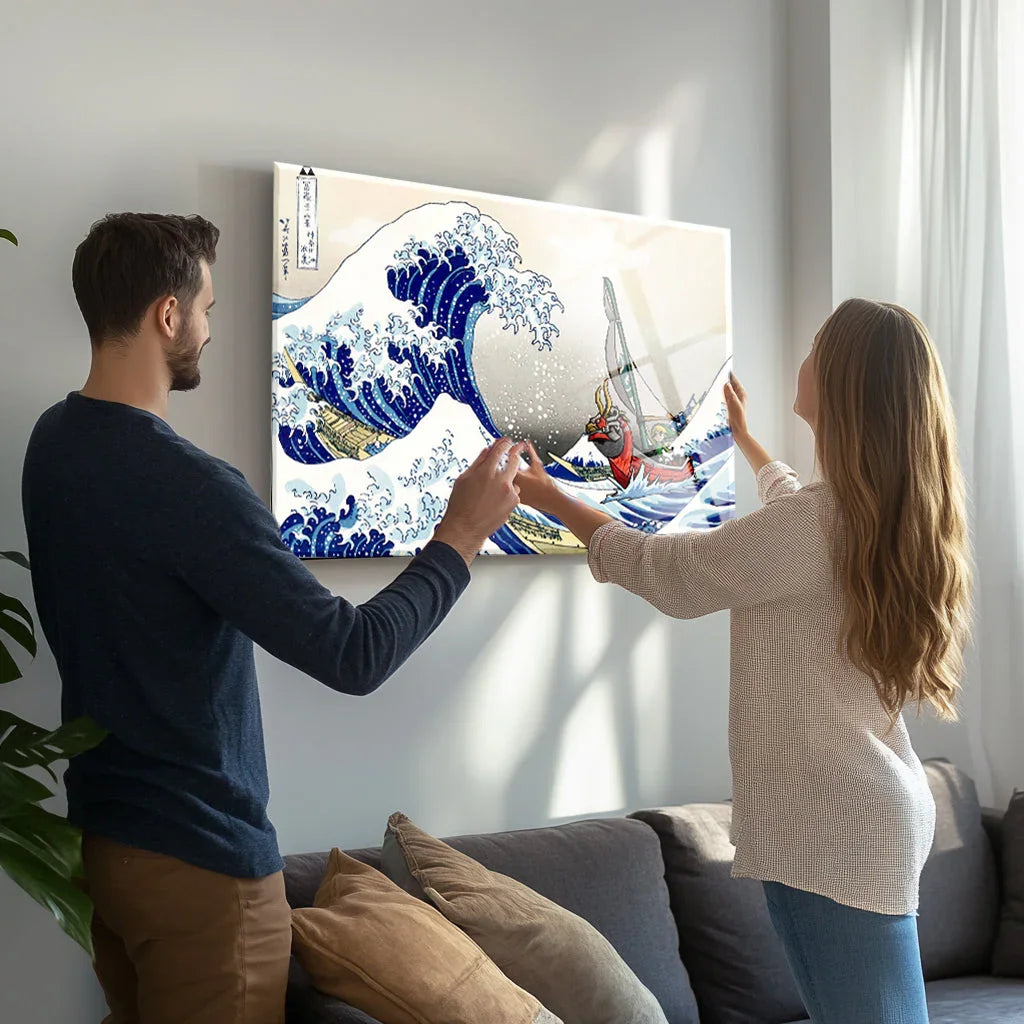
Glass and metallic ChromaLuxe aluminum panels bypass traditional paper distortion issues entirely by fixing the image to an inert rigid plane. Inert materials like glass reject moisture, eliminating the need for Japanese Kozo hinges in Miami or New Orleans summer humidity levels. The Glowing Magic Ring Fantasy Glass Wall Art demonstrates this structural advantage. High-contrast gold against deep black requires zero framing intervention. Its tempered glass surface eliminates the static charge accumulation that Architectural Digest notes flattens spatial depth in budget acrylic enclosures.

Tempered glass maintains sharp cartographic focus for brighter palettes due to its inherent rigidity, perfectly demonstrated by the Hobbit-Style Green Hills Fantasy Glass Wall Art. Desaturated blue-green tones, specifically Munsell hue 10BG, fuse permanently to the medium. Edge-cockling cannot occur to cast micro-shadows across the image surface. Because determining your framing methodology before picking an artwork size dictates structural success, rigid glass provides a key advantage: it scales effortlessly across expansive Knauf Wallboard spans without the prohibitive costs of custom archival framing. While brushed Dibond metal prints offer similar rigidity, tempered glass provides a superior reflective depth that interacts dynamically with ambient LED room lighting.

The interplay between 4000K Lutron-controlled LED lighting and the architectural geometry of the Elven Waterfall Kingdom Glass Wall Art, Fantasy Castle Scene visually anchors large rooms. It provides a dense visual weight that a framed Hahnemühle paper print simply cannot match. Hang glass substrate pieces with their centre exactly 145 cm from the floor to meet standard adult sightlines without vertical distortion.

Executing an Archival Retrofit on Standard Enclosures
Establishing your structural longevity plan dictates the framing strategy before art size selection occurs, ensuring the chosen aesthetic remains visually anchored regardless of interior humidity shifts. Modifying a standard Nielsen Bainbridge metal frame with inert barrier materials bridges the financial gap between budget display and conservation geometry. Hugh Phibbs, former Coordinator of Graphic Conservation at the National Gallery of Art, confirms that standard chipboard backings act as chemical reservoirs. They off-gas acidic volatiles directly into the cellulose structure of the artwork within 24 to 36 months, regardless of the print quality. Executing a highly effective archival retrofit on off-the-shelf frames completely isolates the print from the inferior commercial components.
- Discard the included MDF or corrugated cardboard backing board immediately upon unpacking the commercial frame.
- Seal the exposed rebate wood or polystyrene with aluminium barrier tape like Marvelseal 360 to block volatile organic compounds from entering the enclosure.
- Insert a barrier layer of 2-ply 100 percent cotton rag barrier board or 3 mm acid-free buffered foam board directly behind the print.
Maintain a continuous 1.5 mm separation between the art surface and the glazing by applying inert acrylic frame spacers like FrameTek Econospace inside the rebate to prevent ink transfer to Tru Vue glass. Ultimately, calculating your archival preservation limits before choosing print dimensions guarantees your display survives for decades. Prioritising these precise archival mechanics guarantees lasting visual impact when selecting your next piece from the Middle-earth art collection.