

Beyond Decoration: Luxury Office Wall Art as a Time Tool
The most luxurious workspaces dictate perceived time to control cognitive momentum, utilizing precise temporal anchoring to eliminate the invisible friction of undefined hours. Temporal dissonance occurs when an office lacks a defined time of day, creating fatigue despite precise 4000K Philips Hue lighting and balanced spatial geometry. By curating pieces for executive walls through the strict lens of temporal anchoring, commercial architects force the environment to align with human circadian rhythms. Cool palettes simulate the high-acuity focus of 8:00 AM. Warm amber tones replicate the expansive, strategic reflection of 4:00 PM. This is not about simple colour temperature; it is a calculated application of environmental psychology.
Establishing the Morning Condition
Cool-toned, matte-framed archival prints construct a cognitive environment optimized for high-acuity morning focus. Desaturated blue-green tones, specifically Munsell hue 10BG, actively lower the viewer's resting heart rate, physically mimicking the clarity of early morning daylight. The effect is immediate. For maximum impact, specify a zero-glare substrate by printing on heavy matte 310 gsm Hahnemühle Photo Rag paper paired with 2.5mm Tru Vue Water White Museum Glass. This specific combination drops surface reflectance to less than 1 percent while maintaining a 99 percent light transmission rate, completely eliminating paper-level specular reflection. The artwork functions as a permanent, passive architectural element rather than simple decoration. Mount the center point of the Roma Moulding framed piece exactly 145 cm from the floor to meet the standard adult standing eye level.
Consider the Blooming Meadow and Mountain Lake - Hudson River Oil Painting for this exact application. As a strategic focal point, this Hudson River School composition utilizes sharp atmospheric perspective and cool mountainous tones that immediately signal early morning clarity. According to Kaplan's Attention Restoration Theory, biophilic design elements in high-stress financial or legal work environments noticeably reduce cognitive fatigue.

In poorly lit spaces like North-facing architectural alcoves illuminated by standard 3000K fluorescent troffers during late afternoon hours, zero-glare cool tones function as clinically detached and visually cold planes.
Why Reflective Surfaces Activate Stagnant Architecture
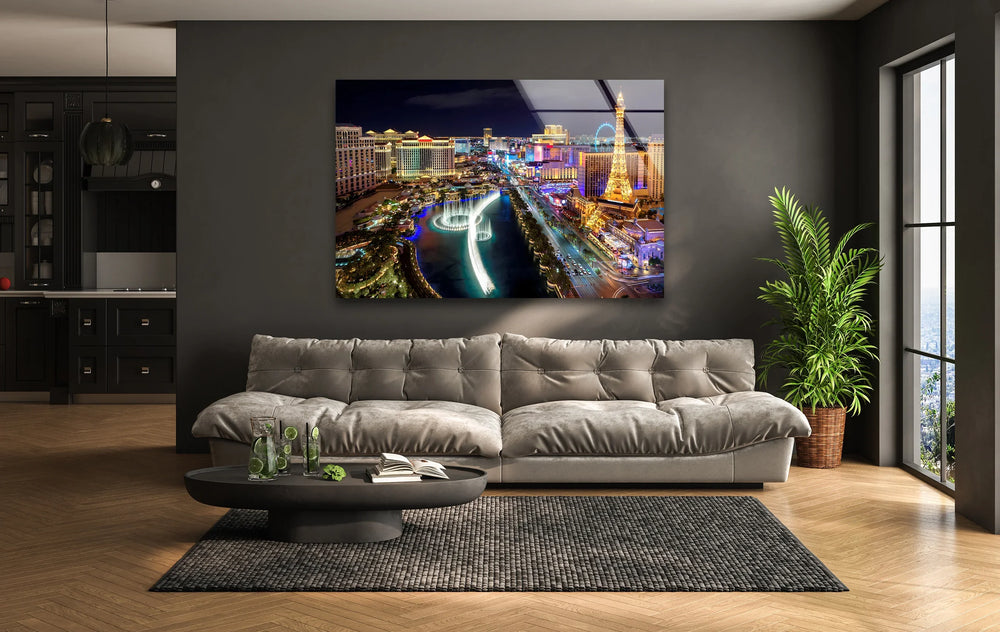
High-gloss substrates with warm architectural tones physically integrate the room into the art to turn a static wall into a dynamic spatial anchor. Mainstream design advice insists on the absolute elimination of glare through matte papers and museum glass, but ultra-minimalist executive offices require a different approach. In stark spaces dominated by polished architectural concrete, brushed steel, and low-iron glass, a completely glare-free print functions as a passive, flat surface. Standard float-mounted FujiFlex Crystal Archive acrylic prints possess an 8 percent surface reflectance. Such reflectance acts as an active architectural lens. This specific 8 percent surface reflectance achieves dynamic temporal anchoring, continuously shifting the workspace's perceived time of day to sustain the expansive cognitive momentum of 4:00 PM strategic thinking. By reflecting subtle shifts in daylight, passing shadows, and ambient movement, the glossy surface physically integrates the surrounding room into its face.
When executing this strategy, apply the 75 percent scale rule. A single, large-format piece of art must fill at least two-thirds of the width of the Herman Miller executive desk below it to establish a firm visual center of gravity. The Journey Across the Plains - Native American Wagon Historic Oil Painting serves this exact architectural function. Dominant Pantone 151 C amber and burnt sienna tones anchor the space in late afternoon warmth, dictating the conclusion of a productive day rather than the start of one.

The physical trade-off is highly specific. Placing standard acrylic face-mounting directly opposite floor-to-ceiling Cortizo Cor Vision windows or under recessed Philips Master LEDspot downlights creates harsh specular reflections. Glare obscures fine details and forces the viewer's macula to constantly adjust, inducing severe visual fatigue over long hours.
| Design Factor | Morning Condition (Matte/Cool) | Afternoon Condition (Glossy/Warm) |
|---|---|---|
| Cognitive Momentum Target | High-acuity, isolated task focus | Expansive, strategic reflection |
| Surface Reflectance Metric | Less than 1 percent via Museum Glass | Approximately 8 percent via Standard Acrylic |
| Architectural Function | Passive spatial grounding | Dynamic environmental lens |
| Optimal Furniture Scaling | 50 percent of desk width minimum | 75 percent of desk width strict mandate |
The Deciding Factor
Luxurious workspaces do not just manage physical square footage; they dictate the perceived time of day to control cognitive momentum through deliberate temporal anchoring. The correct choice depends entirely on your natural peak productivity hours and the existing material palette of your corporate workspace. Assess your cognitive rhythm rather than following arbitrary Pinterest decorating trends. If you require absolute focus to execute complex Python data analysis or financial modeling before noon, select cool tones framed in low-iron Groglass Artglass AR 99 museum glass. For roles demanding big-picture strategic thinking and late-afternoon board meetings, deploy Kodak Metallic warm-toned acrylic prints to actively reflect and warm the ambient light. When your environmental temporal anchoring aligns with your Circadian biological rhythm, you stop fighting the room and start leveraging it. Aligning your workspace with your natural rhythm begins with reviewing a curated professional collection.