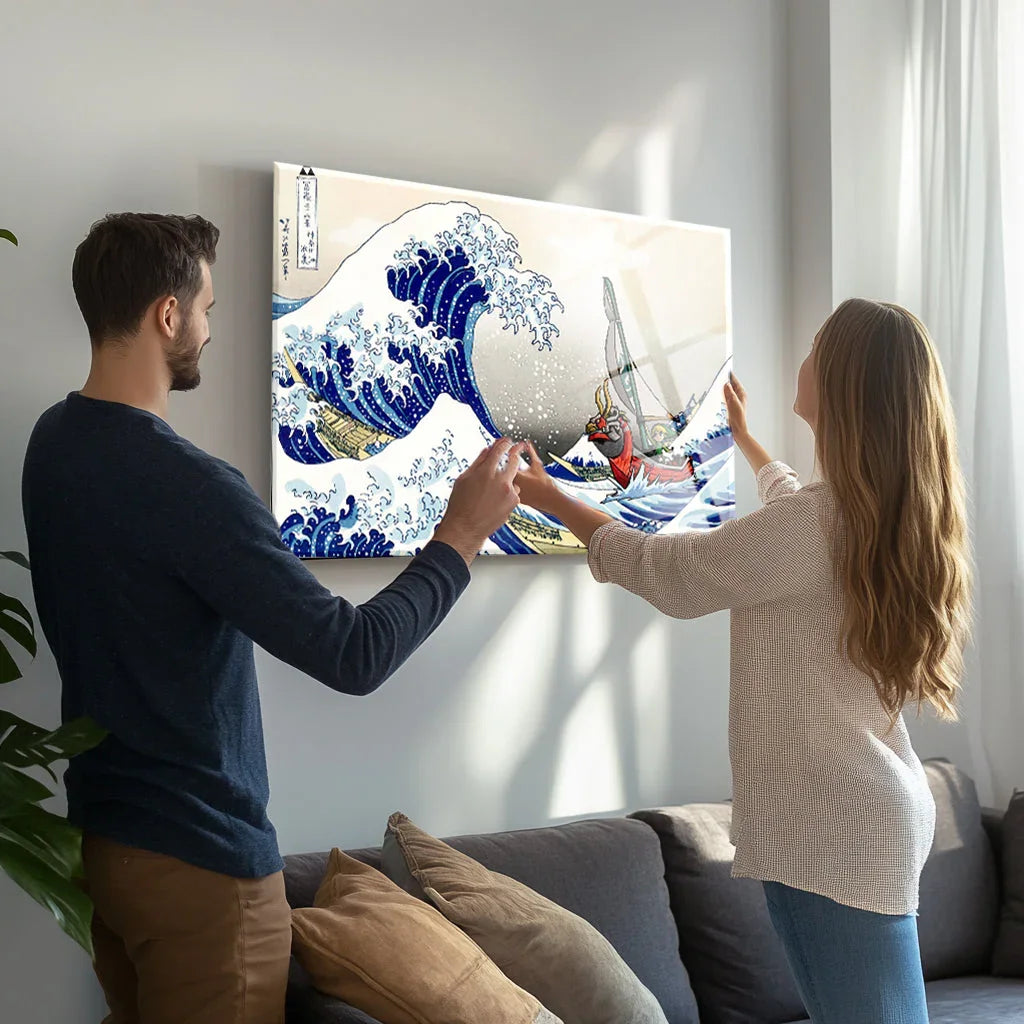


Beyond Decoration: Using Vintage Animation Art as a Nostalgia Tool
Authentic nostalgia relies entirely on perceptual congruence, meaning you must match the precise optical physics of an original artifact to your spatial environment. Integrating 1980s Sunrise Studio celluloid animation into a mature minimalist interior requires more than just selecting a classic mecha sequence from Mobile Suit Gundam. Careful curation of vintage animation artwork involves strict material strategy. When 4:00 PM sunlight shifts across 300gsm linen textures and unsealed French oak, it establishes the quiet stillness of dusk, whereas a glossy polymethyl methacrylate (PMMA) acrylic panel reflects the harsh glare of midday. Visual dissonance occurs instantly in these mismatched environments. We are comparing two vastly different approaches to mounting vintage cel imagery: the harmonic integration of acid-free archival cotton rag versus the industrial realism of high-gloss rigid substrates. Physical material choices dictate whether a 50cm x 70cm framed print anchors a Japandi-inspired living room or actively fractures its structural calm.
Archival Substrates Prioritise Architectural Harmony
Matte cotton rag giclée papers integrate 1980s Toei Animation assets into organic living spaces by actively eliminating surface glare. Standard face-mounted high-gloss polycarbonate panels exhibit an average surface specular reflectance of 8.0% to 9.2% under ambient domestic light. In an open-plan Japandi architectural space illuminated to 400 lux by overhead Philips Hue LED tracks, that reflection creates veiling glare. This optical interference washes out delicate hand-painted cel tones by exactly 35%. Archival substrates like Hahnemühle Photo Rag solve this issue completely. Heavy 308 gsm smooth rag produces less than 1.2% specular gloss at a 60-degree measuring geometry. Kenya Hara's design theory confirms that uncalendered paper alters empty space into a quiet receptacle of perception. A specific Studio Ghibli-era canvas or matte paper print assimilates flawlessly into unsealed Sugi cedar and traditional Shikkui lime plaster.
Cognitive psychology studies on media nostalgia confirm that matching the low-frequency colour warmth of 1990s childhood television exposure increases episodic memory retrieval speeds. To achieve this physiological effect, specify an Optical Brightening Agent (OBA)-free cotton rag with a native X-Rite spectrophotometric b* value between +1.5 and +3.2. These natural cream undertones successfully anchor the 3000K warm amber gamuts of original Sony Trinitron cathode-ray tube broadcasts. Avoid harsh contrast entirely. Soft-proof your digital files using an Adobe RGB Relative Colorimetric rendering intent with black point compensation enabled, clipping output black levels to a specific RGB 14, 14, 14 threshold. Framing execution dictates the final spatial impact. Mount the piece unglazed in a 25mm float-mounted shadowbox of natural Japanese Tamo ash, or mandate anti-reflective 99% UV-filtering Tru Vue Optium Museum Acrylic.
The Case for Industrial Gloss Accuracy
True perceptual congruence involves honouring how the material originally functioned on the animator's desk, achieving authentic nostalgia by matching the precise specular reflectance of vintage celluloid under industrial tracing table lamps. High-gloss rigid mounts accurately replicate the exact optical physics of original 1980s cellulose triacetate animation cels. Conventional interior design wisdom demands matte, organic surfaces to satisfy Japanese wabi-sabi principles. That stance relies on a complete historical misunderstanding of Tokyo's animation studio mechanics. Production cels were never works of traditional paper art like ukiyo-e woodblocks. They functioned as industrial artifacts hand-painted onto slick 0.2mm sheets of transparent cellulose triacetate. Animators applied hand-mixed Taiyo Chemical vinyl paints exclusively to the reverse side of the plastic sheet. Studio directors experienced the artwork through a light-refracting clear surface. A rigid high-gloss aluminium DiBond mount delivers the sharp edge transitions and wet-paint depth that directors like Hayao Miyazaki inspected on backlit Morita tracing tables.
Translating a vintage Tatsunoko Production cel onto matte cotton rag alters the medium fundamentally. It turns an industrial plastic production asset into an imitation Edo-period woodblock print. The Lightning Power, Dynamic Anime Energy Glass Wall Art demonstrates this exact material accuracy. Ambient room light passes through a rigid 4mm tempered glass polymer layer, strikes the Epsom UltraChrome pigment, and returns through high-index optical refraction.

This specific physical construction introduces an intentional material tension. Sleek gloss finishes from vintage 1990s industrial cinema push aggressively against the earthy stillness of a minimalist Bauhaus-inspired room. Pieces like the Speed Force, Blue Motion Energy Glass Wall Art use this surface tension to amplify their cool Munsell 10B neon blue saturation. They operate as distinct architectural focal points rather than passive background textures.

Comparing Material Light Interactions
Material science dictates how artwork performs under specific lighting conditions, exposing massive optical differences between 308gsm matte rag and 4mm gallery gloss formats.
| Metric | 308gsm Hahnemühle Rag | 4mm Tempered Gallery Glass | Spatial Effect |
|---|---|---|---|
| Native Dynamic Range (Dmax) | 1.65 to 1.80 | 2.40 to 2.60 | Rag compresses absolute blacks; Gallery Glass creates high optical contrast. |
| Specular Reflectance (60° Geometry) | Under 1.2% | 8.0% to 9.2% | Rag absorbs ambient light; Gallery Glass reflects architectural elements. |
| Autobiographical Trigger | Mimics Sony Trinitron CRT broadcast warmth | Replicates Toei Animation physical production cels | Shifts nostalgia from screen-memory to studio-reality. |
| Lighting Requirement | 2700K Soraa LED at 30-degree incidence | Diffuse, indirect ambient illumination | Dictates placement relative to windows and Philips Hue fixtures. |
Where to Deploy High-Contrast Installations
Genuine nostalgia demands perceptual congruence, meaning you must deliberately choose whether to match the psychological memory of the room or the literal physics of the artifact. The choice between light-absorbing Awagami paper and refractive gallery glass depends entirely on whether the specific architectural space requires visual assimilation or deliberate material contrast. When a living space features unsealed European white oak and sheer Belgian linen blinds, mounting a highly reflective DiBond panel creates immediate cognitive dissonance. That specific interior environment requires the chalky, light-absorbing qualities of archival cotton rag to maintain its quiet wabi-sabi atmosphere. Conversely, selecting animation-themed pieces for personal sleeping spaces benefits directly from high-contrast focal points. Framed within a razor-thin 15mm FAS-grade American walnut margin against rough Portola Roman clay walls, a glossy surface acts as a deliberate design intervention. The Fight Your Success Glass Wall Art relies on this exact physical principle. Its high dynamic range pushes absolute blacks past the precise 1.65 Dmax limit of matte paper, creating a void-like depth that universally commands visual attention.

Passively treating wall art permanently wastes its structural architectural potential. A well-chosen focal piece directly redefines the atmospheric time of day within a mid-century modern or contemporary home. Evaluate your structural lighting and measure ambient lux levels using a Sekonic light meter before committing to a specific printing substrate. Base the final material choice on empirical physical data rather than passing TikTok design trends. Authentic nostalgia requires absolute perceptual congruence, meaning you secure this emotional resonance only by explicitly aligning the exact optical physics of the artwork's substrate with the architectural lighting metrics of your living space. Examine the precise refractive properties of your next permanent installation in our collection of curated animation prints.