

Budget Planning: The Missing Element in Asymmetric Wall Art
Effective budget planning for residential interior architecture relies on bypassing the custom framing industry's 100 United-Inch pricing cliff by clustering standard 24x36-inch and 11x14-inch giclée prints instead of overspending on monolithic canvases. The custom framing industry hides this severe pricing cliff just past the 40x60-inch mark, punishing buyers of oversized linen canvases with 300 to 500 percent markups for structural wooden strainers and acrylic glass rather than aesthetic visual upgrades. Distributing visual mass across modular, standard-sized gallery frames protects your capital. Securing well-proportioned asymmetric wall art prevents you from commissioning bespoke artwork that looks inadequate in its designated architectural environment.
The Structural Penalty of Large Format Framing
The custom framing industry operates around a strict 100 United-Inch pricing cliff, calculated by adding length and width. Large single 40x60-inch cotton canvases drain interior decor budgets entirely through mechanical structural reinforcements and specialized optical acrylic rather than the printed Fine Art paper itself. Once a piece reaches a 40x60-inch specification, professional framers must abandon standard 2.5mm picture float glass. Standard silica glass shatters under the torque of heavy solid oak gallery frames. The math is unforgiving. Frame shops mandate an immediate switch to 3mm or 4.5mm cast substrates like Tru Vue Conservation Clear Acrylic. The Professional Picture Framers Association dictates that any presentation exceeding 40 inches on its shortest dimension must employ mechanical wooden strainers fastened inside the wood profile. This internal engineering creates an immediate 300 to 500 percent material surcharge. You buy structural engineering, not aesthetic design. Oversized hardware requirements dwarf the cost of the printed archival medium. Source your wall decor in gallery dimensions that avoid heavy-freight crating fees and LTL (Less Than Truckload) delivery surcharges.
How Standardized Clustering Bypasses Custom Surcharges
Grouping off-the-shelf standard frames reduces total material expenditure by up to 83 percent compared to commissioning a single 40x60-inch custom canvas. Producing a custom-framed 40x60-inch fine-art giclée print on 310 gsm Hahnemühle archival cotton rag averages $1,650 across bespoke art fabricators. You achieve equivalent horizontal wall coverage by clustering a 24x36-inch anchor alongside one 16x20-inch and two 11x14-inch prints in ready-made Nielsen aluminum gallery frames. By keeping every individual gallery frame under the 100 United-Inch threshold, you evade the 300 percent structural framing surcharge while commanding the exact same architectural footprint. This specific multi-frame configuration incurs a total retail outlay of just $230 to $360. Utilizing a piece like the Abstract Red Lines Aesthetic Glass Wall Art as your primary focal anchor establishes a vibrant crimson chromatic baseline without demanding a specialized heavy-duty French cleat hanging system. The saturated Munsell red tones command immediate attention, allowing smaller secondary lithograph prints to balance the composition through quantity rather than sheer physical scale. Shrink your frame dimensions. Purchase ready-made gallery frames under 36 inches to qualify for FedEx standard ground shipping and eliminate dimensional freight penalties.

Psychological Rest in Multi-Print Configurations
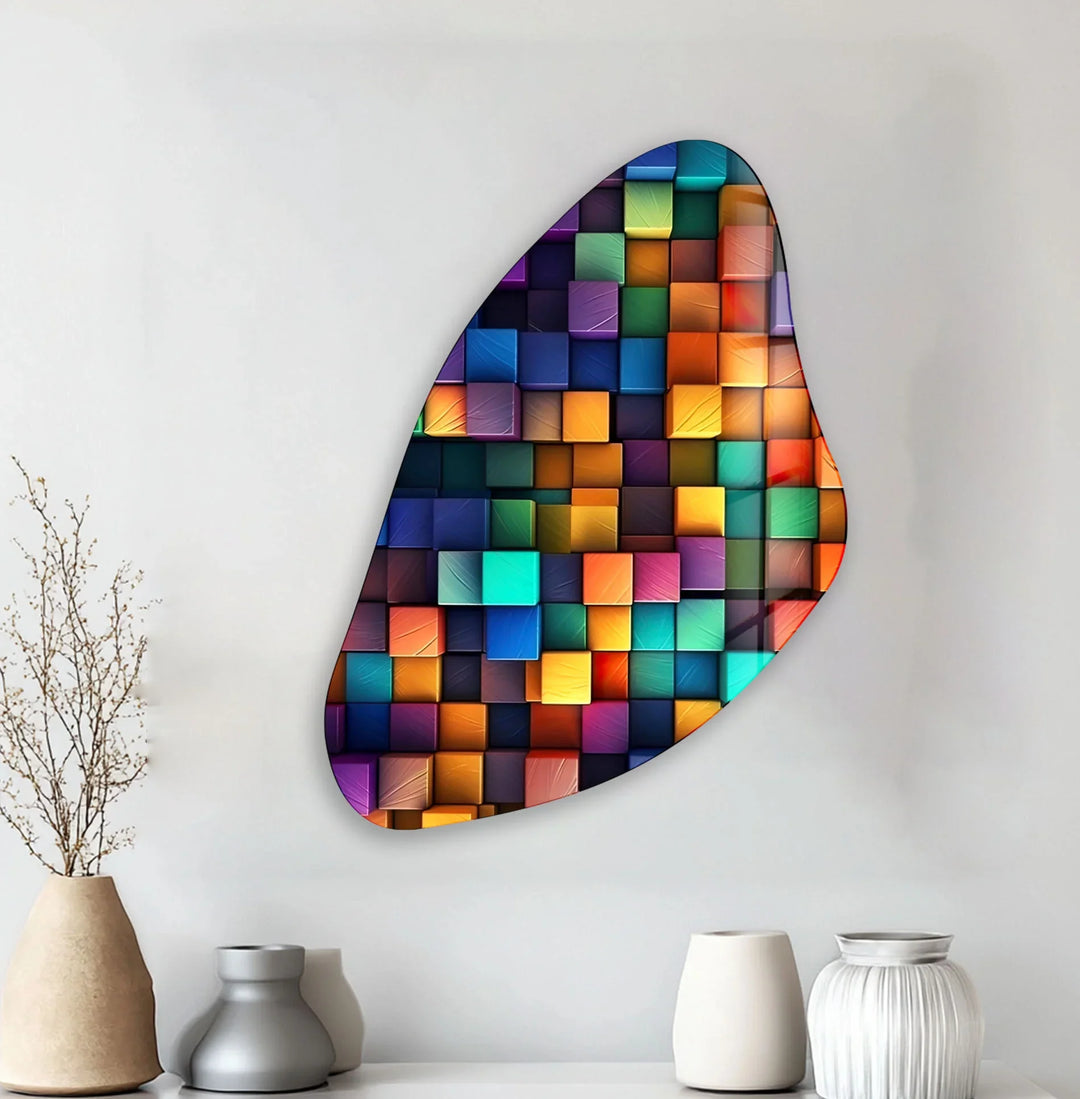
A single oversized statement piece creates aesthetic inertia in an active living room, whereas an asymmetrical multi-piece arrangement provides necessary visual relief. Conventional interior design maxims dictate that massive Bauhaus or Minimalist installations establish a calmer environment by reducing visual variables. Residential living spaces actively reject this rigid theory. An 84-inch mid-century modern sectional sofa represents an inherently asymmetrical geometric zone. You rarely view it from a dead-center seated position, and it sits flanked by offset components like a brushed steel Arco-style floor lamp or a Noguchi walnut end table. A rigid 40x60-inch rectangular monolith creates a harsh visual dead-end. The human eye stops abruptly. This accentuates any structural architectural asymmetry around the room. Incorporating the Abstract Rustic Irregular Glass Wall Art within a staggered layout uses controlled interstitial negative space to guide the viewer across varying focal depths. The irregular organic borders of the tempered glass complement modern Herman Miller furniture silhouettes rather than fighting their inherent 90-degree angles. Embrace modular standard-dimension giclée prints to gain complete layout reconfigurability at zero marginal cost when you update your modular seating.

Executing the 75-Percent Horizontal Envelope
A balanced aesthetic layout demands that your artwork horizontally occupies exactly 66 to 75 percent of the anchoring furniture below it. Gallery curators frequently warn against the floating stamp phenomenon, which occurs when small art gets lost over heavy Chesterfield leather upholstery. Applying the golden two-thirds Fibonacci proportion rule outlines a rigid geometric target envelope. Map out your 2-inch interstitial gaps with blue 3M ScotchBlue painter's tape before hammering a single brass OOK picture hanger nail.
- Calculate the exact 56-to-63-inch target boundary for an 84-inch velvet sofa by multiplying the total furniture width by 0.66 and 0.75, assigning a 24x36-inch ready-made frame off-center to occupy one side.
- Balance the mass of that dominant visual anchor by stacking two 11x14-inch frames vertically directly next to one 16x20-inch frame on the opposite side of the sofa layout.
- Lock the arrangement using a strict 2.0 to 2.5-inch interstitial gap between every adjacent matte black frame edge, keeping the bottom edge exactly 8 to 10 inches above the sofa cushions.
Integrating a structurally fluid piece like the Abstract Grey & Brown Oval Glass Wall Art breaks the rigid grid of standard framing, supplying visual movement without violating Gestalt proximity principles. Spacing wooden gallery frames wider than 3.5 inches causes the human brain to perceive scattered objects rather than a unified architectural facade. Hang your asymmetrical cluster so the virtual horizontal centerline sits at precisely 58 to 60 inches from the floor to match the standard Smithsonian museum viewing heights.

Visual Density Dictates Compositional Balance
True asymmetrical balance relies on contrasting pigment density and physical frame thickness rather than simply equalizing geometric square inches across a drywall partition. Equalizing the square footage of your smaller prints to exactly match the 864 square inches of a 24x36-inch anchor piece bloats the entire composition. Visual weight depends entirely on high-contrast CMYK pigments and thick mahogany framing perimeters. High border density increases visual gravity. A dark charcoal and indigo anchor needs lighter, airy botanical lithograph counterweights. Placing the Silver Elegant Glass Wall Art into your secondary cluster introduces sterling metallic reflectivity that aggressively captures ambient LED room light. This specular highlight visually offsets a much larger matte 300gsm cotton canvas on the opposite side of the sectional arrangement. The metallic brushed finish adds weight through optical luminance, not physical area. Select high-contrast secondary imagery to balance a large muted watercolor landscape anchor without over-buying extra wooden frames.

Evading the custom framing industry's 100 United-Inch pricing cliff by deploying clustered standard frames empowers you to redirect heavy structural engineering funds into higher-quality archival pigments. Dispersing visual mass across modular standard-dimension prints secures dynamic interior architectural balance while preserving liquid capital for future Bauhaus or Mid-Century decor upgrades. Budget planning for residential art is a strict exercise in resource allocation and cognitive human perception, utilizing the Gestalt principle of proximity to make small framed components act as a unified architectural whole. Master the 2-inch interstitial spacing and bypass the 100 United-Inch structural pricing cliff entirely to ensure your sheetrock walls consistently exhibit deliberate, confident scaling without funding invisible Tru Vue acrylic reinforcements. Build your own structurally sound residential layout by integrating modular giclée prints from a targeted collection of asymmetric wall art.